Car Window Tinting Law in Dubai 2026: Legal VLT Percentage Explained
Window tinting in Dubai isn’t really optional in any practical sense. When cabin temperatures climb the way they do here, and the sun is relentless for most of the year, tinted windows are less of a styling choice and more of a comfort necessity. But this is also one of the few car modifications in the UAE that’s directly regulated by federal law, with real fines and the genuine possibility of your vehicle being impounded if you get it wrong.
The frustrating part for most owners is how much conflicting information floats around on this topic. You’ll find sources quoting 30%, others saying 70%, some claiming different limits for front and rear windows. Much of that confusion comes from outdated information that hasn’t been updated since the law changed. This guide lays out what the current regulation actually says, explains what VLT really means in practical terms, and covers the exemptions, penalties, and common misunderstandings that trip people up.
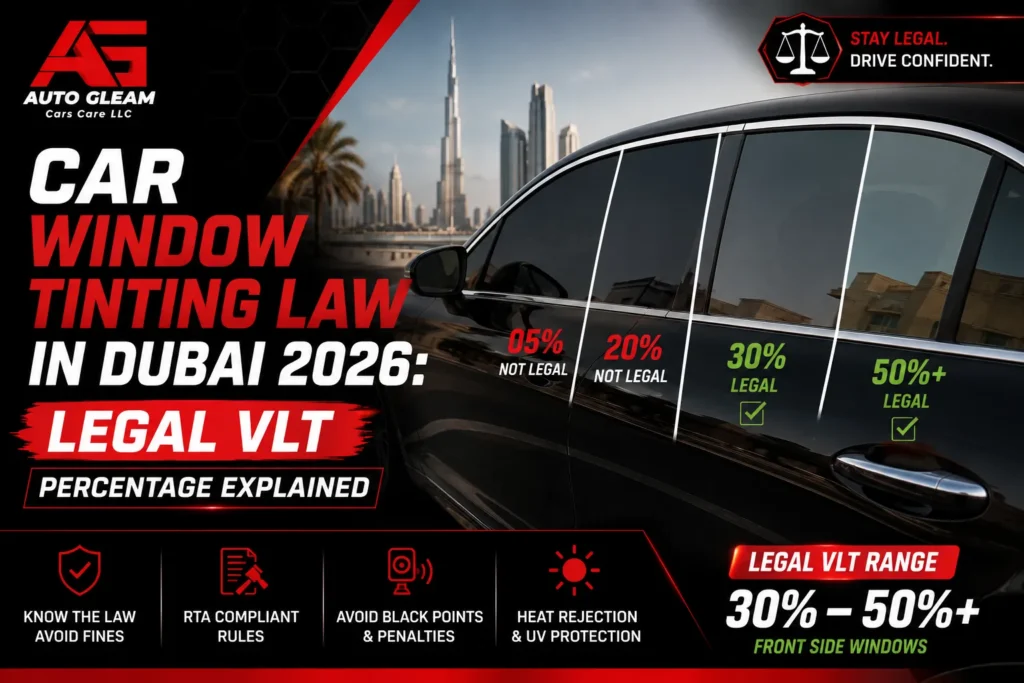
The Short Answer: What’s Legal in Dubai Right Now
Under
- Front side windows, rear side windows, and rear windshield:
- Front windshield:
That’s the core of it. One consistent limit across all tintable windows, and a clear windshield with the exception of that top strip.
Why You See Conflicting Numbers Online
The most common source of confusion is that the limit changed.
The 70% figure that appears in some places usually refers to windshield clarity requirements rather than the side and rear window limit, which adds another layer of confusion when it’s quoted without context.
Understanding VLT: What the Percentage Actually Measures
VLT stands for Visible Light Transmission, and understanding it properly is essential because the way the number works is counterintuitive for a lot of people.
Higher VLT Means Lighter Tint
VLT measures how much visible light passes through the glass, not how much is blocked. So a 50% VLT window allows half the available light through and blocks the other half. A 70% VLT window is lighter, letting more light through. A 20% VLT window would be considerably darker, letting only a fifth of the light through.
This is where people most often make mistakes. Someone asking for “50% tint” at an installer might be thinking they’re getting a film that blocks 50% of light, which happens to align correctly with the law. But someone asking for “30% tint” thinking it’s lighter is actually requesting something significantly darker than the legal limit.
The Law Measures Total VLT, Not Film VLT
This is a critical distinction that catches out a lot of owners. The legal limit applies to the combined result of your film plus your existing factory glass, not to the film’s rating in isolation.
Most modern vehicles come with factory glass that already has some inherent tint, particularly on rear windows, which many manufacturers darken during production. If your factory glass already sits at, say, 70% VLT, and you apply a film rated at 70% VLT on top of it, the combined measurement will be considerably lower than either figure on its own, potentially pushing you below the legal threshold even though the film itself was within limits.
How Enforcement Measures It
Penalties for Exceeding the Legal Limit
The Standard Fine
Vehicle Impoundment
Beyond the fine itself,
Failed Registration Renewal
There’s also a practical consequence that’s easy to overlook.
Fines Can Be Revised
It’s worth noting that penalty amounts are subject to change by the authorities over time. The safest approach is to confirm current figures directly with the RTA or Dubai Police rather than relying on a figure quoted in any article, including this one, and more importantly, to simply stay within the limit in the first place.
What Else Is Prohibited Beyond Darkness Limits
The law doesn’t only regulate how dark your tint can be. There are additional restrictions on the type of film itself.
Reflective and Mirrored Films
Colored Tints
Films in colors such as red, blue, green, or amber are generally not permitted. Standard black and charcoal shades within legal VLT limits are the accepted options.
Complete Black-Out Films
Fully opaque films that eliminate visibility entirely are prohibited, since the entire purpose of the VLT regulation is maintaining a minimum standard of visibility both for the driver looking out and for others looking in.
Different Rules for Different Vehicle Types
Private Passenger Cars
The 50% VLT limit on side and rear windows, with a clear front windshield, applies to privately registered passenger vehicles.
Taxis
Trucks and Commercial Vehicles
Trucks fall under the same prohibition as taxis,
Company and Fleet Vehicles
Medical and Special Exemptions
Medical Exemptions
The law does allow for exceptions in genuine cases.
How the Process Generally Works
Government and VIP Vehicles
Certain government and officially designated vehicles may operate under different permissions, but these are granted through official channels rather than being something a private owner can simply opt into.
Can You Legally Get Good Heat Rejection at 50% VLT?
This is probably the most practically useful question in the whole discussion, because most people want dark tint specifically for heat relief, not for appearance.
Darkness and Heat Rejection Are Not the Same Thing
Here’s the part many owners don’t realize: the darkness of a film and its ability to reject heat are two separate properties. A cheap, very dark dyed film can actually reject less heat than a high-quality lighter film, because most of the heat you feel in a car cabin comes from infrared radiation rather than visible light.
What Modern Film Technology Achieves
Film Types Worth Understanding
- Dyed films: The most basic option, using dye to darken the film. Generally the least expensive, but tend to fade over time and offer weaker heat rejection relative to their darkness.
- Metallic films: Contain metallic particles for heat rejection and are durable, but
- Carbon films: Offer better heat rejection than dyed films without the signal interference associated with metallic construction, and don’t fade in the same way.
- Ceramic and nano-ceramic films: Generally the strongest performers for infrared heat rejection at legal VLT levels, with no signal interference and better long-term stability.
Common Mistakes Owners Make
Assuming the Film Rating Equals the Final Reading
As covered above, the legal measurement is the combined total of film and factory glass. Buying a film rated exactly at the legal limit almost guarantees the final measurement will come in below it once installed over existing tinted glass.
Trusting an Installer’s Verbal Assurance Without Verification
Some installers market darker films without fully explaining the legal consequences to customers. Requesting an actual post-installation VLT meter reading, rather than accepting a general assurance that the work is compliant, is the practical way to confirm where you actually stand.
Assuming Factory Tint Is Automatically Legal
Many vehicles arrive from the factory with privacy glass on rear windows that’s already quite dark. While factory glass is generally manufactured to meet relevant standards, adding any film on top of already-dark factory glass is where problems typically begin.
Tinting the Windshield “Just a Little”
The windshield restriction is not a darkness limit that allows light tint. Aftermarket film on the front windshield isn’t permitted at all, beyond that narrow top strip, regardless of how light the film is.
Assuming Rules Differ Between Emirates
Since the regulation applies federally, tinting to a darker standard because you primarily drive in a different emirate doesn’t provide any protection.
What About Sunroofs and Moonroofs?
How to Verify Your Current Tint Is Legal
Request a VLT Meter Reading
The most direct approach is having the actual total VLT measured with a proper meter, which most professional tinting facilities can perform. This gives you the same measurement an officer would take, rather than an estimate.
Check Before Registration Renewal
Since over-tinted vehicles commonly fail inspection during registration renewal, verifying compliance before your renewal is due avoids the frustration of a failed test and the need for rushed film removal.
Keep Documentation for Exempted Vehicles
If you hold a medical or special exemption, keeping the official approval documentation in the vehicle at all times is essential, since the exemption isn’t visible or verifiable to an officer without it.
What Happens If You Need to Remove Illegal Tint
If you discover your existing tint exceeds the legal limit, film removal is a straightforward process for a professional installer, though it does require care. Older, heavily cured films can leave adhesive residue behind, and aggressive scraping risks damaging rear defroster lines embedded in the rear windshield glass. Professional removal typically uses controlled heat and appropriate solvents to lift film cleanly without damaging the defroster grid or the glass itself.
Practical Advice for Getting It Right
Prioritize Infrared Rejection Over Darkness
If heat is your actual concern, which it is for most people in Dubai, selecting a film based on its infrared rejection performance rather than its visual darkness gets you a better result while keeping you comfortably within the law.
Ask for a Compliance Reading in Writing
Having documented confirmation of your post-installation VLT reading gives you something concrete if the question ever arises, and encourages the installer to actually verify rather than estimate.
Factor In Your Specific Vehicle’s Glass
Because factory glass varies significantly between models and between window positions on the same vehicle, the right film choice for one car isn’t automatically right for another. A vehicle with dark factory privacy glass on the rear may need a much lighter film on those windows than on the front sides to keep total VLT compliant across the whole car.
Verify Current Regulations Before Committing
Laws and penalty amounts do get revised. Confirming the current requirements directly with the RTA or Dubai Police before any installation is the most reliable approach, particularly since so much outdated information circulates on this topic.
Frequently Asked Questions
What is the legal tint percentage in Dubai in 2026?
Private vehicles may have up to 50% VLT on front side windows, rear side windows, and the rear windshield, with the front windshield required to stay clear apart from a narrow strip of roughly 15cm at the top.
Does 50% tint mean the film blocks 50% of light?
It means at least 50% of light must pass through the window in total. Higher VLT numbers mean lighter tint, and lower numbers mean darker tint, which is the opposite of what many people assume.
Is the 50% limit measured on the film alone or the film plus glass?
The measurement applies to the combined total of film and factory glass, which is why a film rated exactly at 50% will typically push the final reading below the legal threshold once installed over existing tinted glass.
What is the fine for illegal window tint in Dubai?
The fine for exceeding the permitted tinting percentage is Dh1,500, with the possibility of vehicle impoundment in some cases. Since penalty amounts can be revised, confirming the current figure with the authorities is advisable.
Can my car be impounded for illegal tint?
Yes, vehicles may be impounded for a period ranging from a week to a month depending on the circumstances of the violation.
Is tinting the front windshield allowed at all?
No aftermarket film is permitted on the front windshield, apart from the narrow sun strip of roughly 15cm at the top, which is where most manufacturers place their factory-applied strip.
Why do some websites say the limit is 30%?
The 30% figure reflects the older pre-2017 rule. The limit was raised to 50% under the federal traffic law revision in July 2017, and many older articles were never updated.
Are the tinting rules different in Abu Dhabi or Sharjah?
No, the regulation applies federally across all seven emirates, so a vehicle tinted legally in one emirate meets the same standard in the others.
Can I get a medical exemption for darker tint?
Yes, drivers with certified medical conditions such as severe sun sensitivity can apply for authorization through the RTA with a valid medical report, and must carry the approval documents in the vehicle.
Are mirrored or reflective tints legal?
No, mirrored and reflective films are strictly prohibited due to the risk of reflected sunlight affecting other drivers’ visibility and making distance judgment harder for pedestrians and vehicles.
Can taxis have tinted windows in Dubai?
No, taxis are not permitted to have tinted windows, and tinting an unpermitted vehicle type carries the same fine as exceeding the darkness limit.
Do company-registered cars follow the same rules as personal cars?
Corporate vehicles may require explicit authorization or need to follow commercial transport guidelines, so assuming identical treatment to a personally registered car isn’t always accurate.
Will illegal tint cause my vehicle registration renewal to fail?
Yes, over-tinted vehicles commonly fail inspection during registration renewal, which is a practical consequence separate from any roadside fine.
Can I get good heat protection while staying within 50% VLT?
Yes. Advanced nano-ceramic films at 50% or even 70% VLT can block a very high proportion of infrared heat, often outperforming cheaper, much darker dyed films while remaining fully legal.
Does darker tint always mean better heat rejection?
No. Darkness relates to visible light, while most cabin heat comes from infrared radiation. A high-quality lighter film can reject significantly more heat than a cheap dark one.
Can I tint my sunroof?
Sunroofs and moonroofs can generally be tinted provided the tint doesn’t obstruct the driver’s clear view, since they aren’t part of the driver’s primary field of vision in the way side windows are.
How can I check whether my current tint is legal?
Having the total VLT measured with a proper meter, which most professional tinting facilities can perform, gives you the same reading an officer would take rather than an estimate based on the film’s rating.
Do metallic films cause any practical problems?
Metallic films can interfere with GPS and mobile phone signals due to their metallic particle content, and any version with a reflective finish would not be legal regardless of its VLT rating.
If my factory glass is already dark, can I still add film?
Possibly, but only if the combined total stays at or above 50% VLT. Vehicles with dark factory privacy glass on rear windows often need a much lighter film on those specific windows to remain compliant.
What happens if I need to remove tint that’s too dark?
Professional film removal uses controlled heat and appropriate solvents to lift the film cleanly. This matters particularly on the rear windshield, where careless scraping can damage the embedded defroster lines.