Paint Protection Film in Al Quoz — What Premium PPF Installation Actually Looks Like at AutoGleam
Published by AutoGleam Car Care LLC | Al Quoz, Dubai | 10 Years of Professional Auto Care
There are dozens of places in Dubai offering Paint Protection Film installation. Type “PPF Al Quoz” into any search engine and the options multiply quickly — workshops, mobile services, detailing studios, body shops that have added film as an afterthought. The range of what passes for “PPF installation” in this market is wider than most vehicle owners realise until they have experienced a poor result and started asking the right questions.
This blog post is about what premium PPF installation genuinely involves — what separates a result that looks perfect after five years from one that starts to lift, yellow, or show contamination inclusions within 18 months. It is written from the perspective of a team that has been doing this work in Al Quoz for over a decade, and it does not hold back on the details that matter.
If you want the short version: the difference between premium and budget PPF installation is almost entirely in the preparation and the environment, not just the film brand. If you want the full picture — read on. And if you are ready to book, message us on WhatsApp any time.
Why Al Quoz Became Dubai’s Home for Serious PPF Work
Al Quoz Industrial Area is where Dubai’s automotive services industry concentrated — not by design, but because the infrastructure supports the work. Covered workshops, professional equipment suppliers, automotive product distributors, and a community of skilled technicians all established themselves here over years. For PPF installation specifically, Al Quoz offers something that retail-facing areas of Dubai cannot: proper workshop conditions.
Paint Protection Film requires dust-controlled, climate-regulated installation environments. Dubai’s ambient air carries fine sand particles continuously. Even a moderate breeze pushes enough particulate matter through open spaces to contaminate the adhesive layer of PPF film during application. This is not a theoretical concern — it is the primary cause of the contamination inclusions (trapped particles visible under the film, sometimes called “pimples”) that appear in poorly installed jobs. Controlling for airborne contamination requires an enclosed, filtered, temperature-regulated bay. That infrastructure exists in Al Quoz workshops. It does not exist on the side of a road, in an open-fronted garage, or in a mobile installation van.
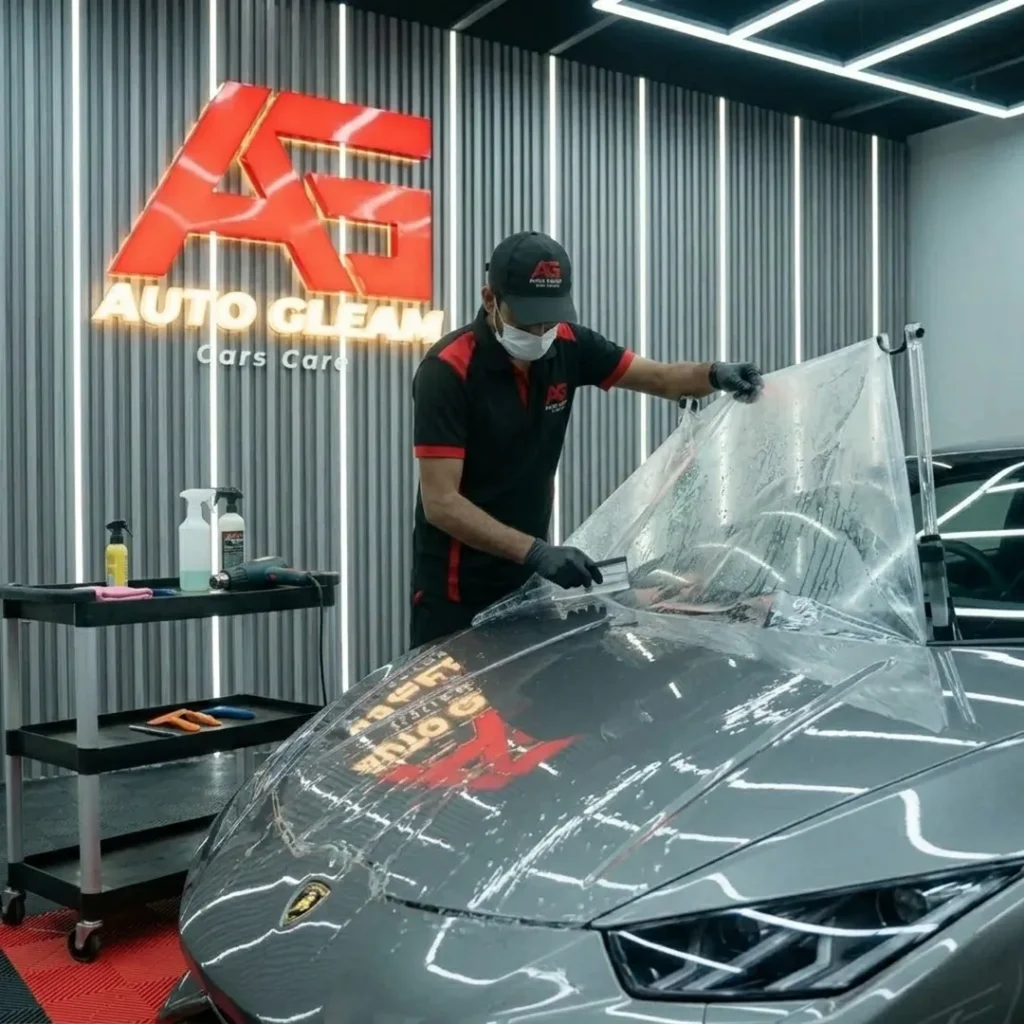
At AutoGleam Car Care LLC, our Al Quoz workshop was built for the work we do. The installation bay is climate-controlled, enclosed, and maintained to minimise the airborne variables that compromise film installations done in less considered environments. This is the baseline requirement for what we describe as premium PPF installation — and it is non-negotiable.
What “Premium PPF” Actually Means — and What It Does Not
The word “premium” is used freely in automotive services marketing. It is worth defining precisely what it means in the context of PPF installation, because the gap between genuine premium work and what most budget installers deliver is significant and visible over time.
Premium Film vs Budget Film — Not the Same Product
The film itself matters, but it is not the most important variable. Premium brands — XPEL, 3M Scotchgard Pro, SunTek, LLumar — have several characteristics that budget and unbranded films do not:
- UV stabiliser packages calibrated for UAE sun exposure — premium films maintain optical clarity for 7–10 years under Dubai’s UV Index 8–11 conditions. Budget films may begin yellowing within 3–5 years as their UV stabilisers exhaust.
- Consistent adhesive chemistry — premium adhesives are formulated to perform through Dubai’s temperature cycling from winter nights (15–18°C) to summer days (40°C+ surface temperatures of 65–75°C on dark paint). Budget adhesives may soften, creep, or lose adhesion under sustained heat.
- Self-healing top coat that actually works in UAE ambient temperatures — not all self-healing films heal equally in the same conditions. Premium brands have top coat formulations that activate at lower temperatures, meaning healing occurs passively from UAE ambient heat rather than requiring boiling water or concentrated heat gun application.
- Digital pattern libraries (XPEL DAP) — precise, model-specific cut patterns that minimise on-vehicle cutting. This matters because on-vehicle cutting with a blade carries an inherent risk of scoring the clear coat beneath the film — a risk that disappears when patterns are cut on a plotter from digital files before going on the vehicle.
Premium Preparation vs Rushed Preparation
The preparation before film application is where most quality differences originate. A premium installation involves:
- Full inspection under proper lighting to map paint condition
- Machine polishing to correct any existing swirl marks, scratches, or oxidation — because PPF locks in whatever is under it
- pH-neutral wash, iron decontamination, and clay bar treatment to remove every trace of bonded surface contamination
- A second inspection after decontamination before the vehicle enters the installation bay
A budget installation typically involves a quick wash, possibly a clay bar, and immediate film application. The difference shows within 12–18 months — locked-in defects, delamination where the adhesive could not bond properly over contaminated surfaces, and visible quality in the finished result that customers who do not know what to look for often do not notice until they see a premium result for comparison.
Premium Installation Technique
Film application is a skill that develops over years of repetitive work on diverse vehicles. It is not a process that can be described in a training manual and then executed perfectly by someone without extensive experience. The specific skills that distinguish experienced installers include:
- Edge tucking — wrapping the film under panel edges rather than cutting at a visible edge line on the paint surface. Tucked edges last longer, look better, and prevent the film from peeling from the edge outward.
- Panel conformity on complex surfaces — getting film to sit flat and bubble-free on compound curves (wheel arch flares, door mirror caps, bumper corners) requires a combination of appropriate heat application and experience-based hand technique.
- Recognition of film stress — knowing when a section of film has been stretched too far in fitting a complex curve, requiring a fresh piece rather than persisting with a section that will relax and lift at the stressed point.
- Seam management on full body installations — where two sections of film meet on a large panel, managing the seam to minimise visibility requires both technique and appropriate film selection.
At AutoGleam, our installers have been doing this work in Al Quoz for over 10 years. The volume of vehicles we have worked through, the diversity of body types and paint systems we have encountered, and the specific conditions of Dubai’s market have produced installers whose technique is developed well beyond what training alone provides.
The PPF Types Available at AutoGleam — A Practical Guide
Not all PPF serves the same purpose. Here is a practical breakdown of the film types we work with and who each is right for.
Clear Gloss PPF — Invisible Protection for Original Finishes
The most commonly installed film type. Clear gloss PPF is optically transparent — the vehicle’s paint colour and gloss show through completely unaltered. When installed correctly on clean, corrected paint, the film is essentially invisible. The only visual clue to its presence is the slightly cleaner, more hydrophobic appearance of the protected surface between washes. This is the right film for any vehicle owner who wants maximum physical protection while maintaining the original factory paint appearance. It works equally well on every colour — from white and silver through to the deepest blacks and carbon fibre.
Matte PPF — Stealth Finish with Full Protection
Matte PPF converts the surface texture of a gloss paint finish to a satin-matte appearance. It provides identical physical protection to clear gloss PPF — stone chips, abrasion, contact damage — while fundamentally changing the vehicle’s visual character. In Dubai’s vehicle culture, matte finishes on SUVs and performance vehicles have become genuinely popular, and matte PPF delivers that finish without the commitment and maintenance demands of a full colour-change wrap.
Matte PPF is also the essential protection choice for factory matte paint finishes — BMW Individual Frozen colours, Mercedes-Benz Manufaktur Magno, Audi exclusive matte finishes. These factory matte paints cannot be polished to repair damage without altering the matte texture. Any scratch or chip is permanent without repainting. Matte PPF protects the finish while maintaining the visual character of the factory paint. XPEL Stealth is the established benchmark product for this application.
Coloured PPF — Protection and Colour Change Combined
Coloured PPF offers colour-change transformation combined with the physical protection properties of premium PPF film. The result is different from a standard vinyl wrap — the self-healing function, stone chip protection, and premium adhesive system of the PPF are present alongside the colour transformation. This is a relatively specialised application used for owners who want both a new look and genuine physical paint protection simultaneously, without committing to separate PPF and wrap layers. We advise on coloured PPF availability for specific vehicles when consulted.
Ceramic-Infused PPF — Film Plus Coating in One
Products like XPEL Ultimate Fusion integrate ceramic coating chemistry into the film’s top coat. This gives the film built-in hydrophobic properties beyond what standard clear PPF provides natively — water beads more aggressively, contamination bonds less strongly to the surface, and the interval between washes where the car still looks clean is extended. For owners who want the combined benefit of PPF and ceramic coating but prefer a single-product approach, ceramic-infused film is the answer. Applied over thoroughly prepared paint, it provides the most comprehensive protection available in a single film application.
10 Signs of a Poor PPF Installation — What to Look For
If you are evaluating PPF installations you have seen or are considering a service provider, here are the visible indicators that separate quality work from rushed or under-resourced installations.
Contamination Inclusions Under the Film
Small bumps or “pimples” visible under the film surface, often most noticeable in raking light. These are dust, sand, or contamination particles trapped in the adhesive layer during application. They indicate insufficient preparation (clay bar and decontamination not performed properly) or installation in a non-dust-controlled environment. These cannot be removed without taking the film off and re-installing.
Visible Edge Lines on Panel Surfaces
Where film ends on the middle of a panel surface rather than being tucked under an edge, a visible ridge or line is left on the paint. Premium installations tuck film edges wherever design allows, leaving a seamless termination. Where a surface edge line is unavoidable, it should be as thin and low as possible. Thick visible edge lines indicate the film was cut with insufficient precision or left untreated after cutting.
Edge Lifting Within the First Year
Film edges that begin to peel within months of installation indicate either surface contamination at the adhesion point or insufficient edge sealing. This is the most common early failure mode on poorly prepared installations. Once an edge begins lifting, it tends to progress along the edge and eventually creates a tunnel under the film that accumulates dirt and moisture.
Yellowing Before the Film’s Expected Lifespan
Any visible yellowing within the first 3–4 years indicates budget film with an inadequate UV stabiliser package for UAE conditions. Premium brands should maintain optical clarity for their full 7–10 year warranty period. Yellowing is irreversible and the film must be fully removed and replaced.
Bubbles That Do Not Resolve During Curing
Some haziness and small bubbles immediately after installation are normal — installation fluid under the film evaporates during the first few days. Bubbles that persist after the first week indicate installation problems: too much slip solution, insufficient squeegee work, or adhesive failure in specific areas.
Uneven Gloss Between Filmed and Unfilmed Sections
If the gloss level of the filmed sections looks noticeably different from adjacent unfilmed paint — either higher or lower — it usually means the paint was not corrected to a consistent baseline before film application, or the film product has an inappropriate sheen for the vehicle’s paint system.
Incorrect Pattern Fit Leaving Paint Gaps or Overhang
Film that does not cover what it should (gaps at bumper edges, uncovered sections of headlights) or that overhangs beyond panel boundaries indicates either incorrect pattern selection or poor hand-cutting. Both leave the vehicle with less protection than intended and a visually untidy result.
Seam Lines in the Middle of Large Panels
Where film sections are joined in the middle of a large panel (like a full bonnet) rather than at natural panel break points or edges, the seam is visible and creates a potential lifting point. Premium installers use film in widths appropriate for the panels being covered to minimise unnecessary seaming.
No Paint Correction Offered or Performed
An installer who does not offer or perform paint correction before film application is either cutting cost or lacks the equipment. Paint correction is a prerequisite for any quality film result — film applied over swirl marks, scratches, or oxidation traps those defects permanently. The correct answer from any installer when asked about paint condition before PPF should always be: “We inspect it first and correct what needs correcting.”
Adhesive Residue Visible at Edges After Some Months
A grey or whitish residue appearing at film edges after several months of use indicates the adhesive is not bonding properly or is being degraded by chemical exposure. This is a film quality or preparation issue that indicates the wrong product for the application or a contaminated bonding surface.
AutoGleam’s Workshop — What the Premium PPF Environment at Al Quoz Looks Like
We have described what a premium PPF environment requires in principle. Here is what it means in practice at AutoGleam’s Al Quoz workshop specifically.
The installation bay is fully enclosed, with no open access to the ambient outdoor environment during film application. Lighting is a combination of overhead fluorescents and directed inspection lights — the standard used in professional paint shops for defect assessment. The temperature is maintained in a range appropriate for film application chemistry — consistent enough that the adhesive performs predictably throughout the process, not affected by the fluctuating temperatures of an open workshop on a Dubai summer afternoon.
The preparation area is physically separate from the installation bay. Washing, decontamination, and polishing happen before the vehicle enters the installation environment — so that none of the water, compound residue, or contamination from preparation stages is present in the installation space when the film goes on.
The pattern cutting station uses the XPEL Design Access Program (DAP) for applicable vehicles — a digital pattern library containing precise, model-specific cut files for thousands of vehicle makes and models. Film is cut on a plotter from digital files before the vehicle enters the bay. The result is panel-accurate pieces that are carried in and applied, minimising the blade work done directly on or near the paint surface.
The paint correction setup includes dual-action and rotary polishers, a range of compounds and pads, and the inspection lighting required to properly assess paint condition before and after correction. Paint correction is not a service that can be approximated with consumer-grade equipment and rushed technique. We have professional equipment and the experience to use it on the range of paint systems found on Dubai’s vehicles — from standard single-stage to the specialist finishes on European luxury and exotic vehicles.
The AutoGleam Premium PPF Installation Process — Every Step
This is a complete walkthrough of what happens to your vehicle from drop-off to collection. Nothing is skipped, regardless of the vehicle type or the scope of coverage being installed.
Step 1: Arrival Inspection and Coverage Consultation
We walk the vehicle with you before starting. Paint condition is assessed under inspection lighting. Existing imperfections — stone chips, scratches, swirl marks, any previous repairs — are noted. Coverage zones are confirmed. You leave knowing exactly what the preparation will address and what the film will cover. No surprises at collection.
Step 2: Pre-Wash and Iron Decontamination
The vehicle is snow-foamed and hand-washed with pH-neutral shampoo using a two-bucket method. Iron decontamination product is applied to all surfaces — it reacts visibly with bonded ferrous particles (brake dust, industrial fallout), dissolving them from the paint surface. These particles are invisible before treatment and would create adhesion problems if left under the film.
Step 3: Clay Bar Decontamination
After chemical decontamination and a thorough rinse, clay bar treatment removes the remaining bonded surface contamination — road tar, tree sap residue, industrial overspray — that washing and iron remover do not fully address. The clay bar physically pulls these from the surface. Before claying, paint feels rough under a gloved hand. After correctly performed clay bar treatment, the surface feels glass-smooth. This is the baseline the film needs to adhere properly.
Step 4: Paint Correction
For vehicles with paint imperfections, machine polishing is performed to the agreed standard. Single-stage correction addresses swirl marks and light scratches. Multi-stage correction works through more significant deterioration. The goal is the paint condition you want preserved under the film — because the film will preserve exactly whatever condition the paint is in at installation, indefinitely. This step is not optional for vehicles with visible paint issues.
Step 5: Post-Correction Inspection
Corrected paint is re-inspected under proper lighting before the vehicle moves to the installation bay. Any sections requiring additional attention are addressed before the film preparation phase is declared complete.
Step 6: Vehicle Transfer to Installation Bay
The clean, corrected vehicle is transferred to the enclosed, climate-controlled installation bay. From this point, no washing, wiping, or additional chemical treatment is applied — the surface is in installation-ready condition and is not contacted again until the film application begins.
Step 7: Pattern Preparation
For XPEL installations, the appropriate vehicle-specific patterns are loaded in the DAP system and cut on the plotter. Film pieces are organised and staged for installation sequence. For panels requiring hand-cutting or custom coverage, templates and film pieces are prepared off-vehicle to minimise on-vehicle blade work.
Step 8: Film Application — Panel by Panel
Film is applied starting at the front of the vehicle and working rearward. Each panel is worked with appropriate slip solution, careful squeegee technique, and systematic air removal. Edges are tucked under panel overlaps where design permits. Complex curves are heat-shaped to conform without stretch-induced stress. Each panel is inspected under the bay lighting before moving to the next.
Step 9: Edge Inspection and Finishing
After all panels are filmed, the installation goes through a specific edge inspection — every termination point examined under directed light to confirm proper adhesion, no lifting, and clean finish. Any edge requiring additional heat-sealing or adjustment is addressed at this stage, before the film has fully set.
Step 10: Curing Period
The installed vehicle remains in the bay for an initial curing period. If time permits, it remains until the installation fluid beneath the film has substantially cleared. The customer is briefed on what the film will look like during the curing period (possible slight haziness in some areas, which clears completely within 5–7 days), what to avoid (washing, high-pressure water, sustained direct sun where possible) in the first 48 hours, and what long-term maintenance involves.
Step 11: Customer Handover and Aftercare Briefing
We walk the installation with you under the inspection lighting before you leave. Every panel is shown. The aftercare guidance is given in detail — not handed over as a generic information sheet. Questions are answered. You understand exactly what you are driving away with and how to maintain it.
Why Dubai’s Conditions Make Premium PPF More Valuable Than Anywhere Else
Paint Protection Film is available and used globally. The argument for premium installation quality is relevant everywhere. But Dubai’s specific conditions make the consequences of the installation quality difference more visible and more financially significant than in most markets.
In a temperate climate with moderate UV and no sand, a budget film installation may show its compromises slowly over 3–4 years. In Dubai, the same film installed in the same imperfect way shows those compromises within 12–18 months. The UV is higher. The heat cycling is more extreme. The sand abrasion is continuous. The salt air (in coastal areas) is persistent. Every factor that causes a film to degrade, peel, yellow, or fail adhesion-wise is more intense in Dubai than in most markets where PPF is used.
This means the quality of the installation matters more in Dubai, not less. The vehicle owner who accepts a cheaper installation to save on day-one cost discovers within 18 months that the cheaper result requires removal and reinstallation — paying twice. The vehicle owner who invests in a premium installation at the outset gets the 7–10 year result the premium brands warrant. In Dubai’s conditions, the premium quality gap is not a preference — it is the difference between a product that works and one that does not, over the timeline the investment is supposed to cover.
PPF and the Full AutoGleam Service Menu — Complete Care in One Location
PPF is what many AutoGleam customers come for first. The full service menu keeps them returning for everything their vehicle needs.
- PPF Installation Dubai — full body and partial coverage with premium brands as detailed in this blog
- Ceramic Coating Dubai — applied over PPF for enhanced hydrophobic performance, or directly to paint
- Car Detailing Dubai — full interior and exterior detailing and paint preparation for protection services
- Car Polishing Dubai — machine paint correction that precedes PPF installation and is available standalone
- Car Window Tinting Dubai — UV and heat rejection film for interior protection alongside exterior PPF
- Car Wrapping Dubai — vinyl colour-change wraps alongside or as an alternative to PPF
- Car Interior Cleaning Dubai — deep cleaning, steam sanitisation, and leather care
- Car Denting & Painting Dubai — bodywork repair before PPF installation
- Paintless Dent Removal (PDR) Dubai — dent repair without repainting on undamaged paint
- Wheel Rim Refurbishment Dubai — alloy wheel restoration and refinishing
40 Questions About Premium PPF Installation in Al Quoz — Answered
Questions About Premium vs Standard PPF
1. What makes PPF installation “premium” compared to standard installation?
Premium PPF installation is defined by four things: the film brand (UV-stabilised, self-healing, warranted premium products vs unbranded or budget alternatives), the preparation depth (proper paint correction, full decontamination, clay bar), the installation environment (enclosed, climate-controlled, dust-controlled bay vs open-air or non-specialist locations), and the installer’s technique (edge tucking, pattern precision, panel conformity, finished quality inspection). Most “standard” installations compromise on at least two of these four. Premium installation maintains all four. The visible difference emerges progressively — the premium installation still looks excellent at year five; the compromised one shows its limitations within 18 months.
2. Is premium PPF worth the extra investment in Dubai?
Yes — more clearly in Dubai than in most markets. Dubai’s UV Index, heat, and sand abrasion conditions accelerate every PPF failure mode: yellowing, adhesion failure, edge lifting, self-healing loss. Budget film that might last 5 years in a temperate climate may show significant degradation in 2–3 years in the UAE. Premium film installed correctly lasts 7–10 years in UAE conditions. The cost difference between premium and budget installation, amortised over the film’s service life, is typically smaller than the cost of removing and reinstalling a failed budget installation before its expected lifespan.
3. How do I verify that a PPF installer in Al Quoz is actually doing premium work?
Ask four questions: What film brands do you use, and can you show the brand documentation? What is your preparation process before film application — specifically, do you perform clay bar decontamination and paint correction? What is your installation environment — can I see the bay where film is applied? And what does your edge treatment look like on the finished installation — do you tuck edges or cut on the surface? An installer who cannot answer all four clearly or who becomes defensive when asked is telling you something about their process. A premium installer welcomes these questions.
4. What is the XPEL Design Access Program and why does AutoGleam use it?
XPEL’s Design Access Program (DAP) is a digital library of precise, vehicle model-specific cut patterns for thousands of makes and models. Instead of cutting film to shape directly on the painted panel — which requires a blade near the clear coat surface, with inherent scoring risk — DAP patterns are plotted on a precision cutter and applied as pre-shaped pieces. The result is tighter edge coverage, more consistent panel-to-panel fit, and elimination of the on-vehicle cut scoring risk. It is one of the practical reasons XPEL is the professional installer’s benchmark product, and why we use DAP for all applicable installations.
5. Why does paint correction before PPF matter so much?
PPF is a permanent protective layer. Whatever the paint condition is at the time of installation is what the film preserves and amplifies for its entire service life. Swirl marks under clear PPF look like swirl marks in clear PPF — the film adds clarity and depth that makes imperfections more visible, not less. Paint correction before installation is not a luxury add-on; it is the step that determines whether the finished installation looks like perfection or like perfection overlaid on a problem. We never recommend installing PPF over uncorrected paint for any vehicle where the paint has visible imperfections.
6. What happens if PPF is installed without clay bar treatment?
Without clay bar treatment, the paint surface retains bonded contamination — industrial fallout, road tar micro-particles, overspray residue — that is invisible to the naked eye but present in the texture of the surface. When film is applied over contaminated paint, the contamination particles sit in the adhesive layer and become visible “pimples” or inclusions under the film. They also create micro-voids in the adhesive that affect long-term bonding performance. The only way to remove these inclusions is to remove the film, properly decontaminate the surface, and reinstall. Doing the clay bar correctly the first time avoids this entirely.
7. How does the installation environment affect PPF quality?
The installation environment is the factor most vehicle owners do not think to ask about and the one that most directly determines whether the finished installation is free of contamination inclusions. Dubai’s ambient air in Al Quoz and anywhere else in the city carries fine sand and dust particles at all times — wind, vehicle traffic, and human activity keep them airborne. During film application, the adhesive layer is exposed to the air of the installation environment. In an open or non-enclosed space, those particles land in the adhesive before the film is pressed down. In an enclosed, filtered bay, they do not. The difference is visible in the finished result: inclusions versus clean, clear film.
Technical PPF Questions
8. What is the construction of a premium PPF film?
Premium PPF is a multi-layer product. The base adhesive layer bonds to the painted surface and is formulated for performance across UAE temperature cycling. The polyurethane body layer provides the physical impact absorption that is the film’s core function — typically 6–8 mils (thousandths of an inch) of material capable of absorbing stone chip impacts that would penetrate paint. The top clear coat is the self-healing layer — a polymer formulated to flow back to its original level when heat is applied, erasing fine surface scratches. Each layer in a premium film is engineered specifically for automotive protection in high UV, high heat, and abrasive conditions.
9. How does self-healing PPF work and how quickly does it heal in Dubai?
The self-healing top coat is a shape-memory polymer — when heat is applied after the film surface is disturbed by a scratch, the polymer flows back to its pre-scratch level, eliminating the mark. In Dubai’s ambient temperatures (30°C+ through most of the year, with paint surface temperatures much higher), this healing occurs passively and relatively quickly. A fine scratch from a brushed contact in a car park may heal within 20–30 minutes of sun exposure in a Dubai summer. In winter, when ambient temperatures are lower, healing is slower — warm water poured over the scratch accelerates it. This passive healing function is one of the most practically valuable aspects of premium PPF in Dubai’s climate, where minor surface marks accumulate regularly.
10. What is the difference between the 5-year and 10-year warranty film products?
Warranty periods on PPF products reflect the manufacturer’s confidence in the film’s UV stability and adhesive performance over time. 5-year warranty products have sufficient UV stabilisation for moderate UV environments. 10-year warranty products have enhanced UV stabilisation packages designed for high-intensity UV markets like the UAE, Australia, and southern European countries. In Dubai’s UV Index 8–11 environment, the difference between 5-year and 10-year UV stability is visible by year 4–6 — the 5-year film may begin showing optical degradation while the 10-year film remains clear. For any vehicle in Dubai, 10-year warranty products from premium brands are the appropriate choice.
11. What is the minimum PPF coverage that makes sense for any vehicle in Dubai?
A comprehensive front protection package — full bonnet, full front bumper, both front wings, both mirrors, and both headlights. This coverage addresses the five surfaces that absorb approximately 80% of the stone chip, sand abrasion, and road debris damage that a Dubai vehicle accumulates in normal use. Partial front coverage (bumper only, or partial bonnet) leaves the vehicle’s most frequently damaged surfaces unprotected. For any vehicle used on Dubai’s main roads — Sheikh Zayed Road, Al Ittihad Road, Emirates Road — the full front package is the minimum that delivers meaningful protection against the actual risk.
12. Can PPF be applied over existing paint protection products?
No other coating or sealant should be on the paint when PPF is applied. Ceramic coating must be removed from areas receiving PPF before installation — the coating layer prevents proper PPF adhesive bonding. Wax and polymer sealants are removed during the decontamination and clay bar preparation stage. PPF is always applied to clean, decontaminated, bare paint. Ceramic coating can then be applied over the PPF after installation and curing — this is the correct sequence for combining both products.
13. What is the correct sequence for PPF, ceramic coating, and window tinting?
The correct sequence: paint correction and decontamination first, then PPF installation, then PPF curing (5–7 days before ceramic coating application), then ceramic coating over the PPF and on unfilmed panels. Window tinting can be done at any stage since it goes on glass, not painted surfaces — most efficiently combined with the PPF installation visit or the ceramic coating visit. Attempting to apply PPF over ceramic coating, or ceramic coating before the PPF adhesive has fully cured, compromises both services.
14. Why is on-vehicle blade cutting a concern with PPF installation?
On-vehicle blade cutting means using a knife or blade to cut the film to shape while it is on the painted panel surface. The risk is scoring the clear coat — applying enough pressure through the film to mark the clear coat beneath, leaving a scratch that will be visible when the film is eventually removed. For vehicles with thin or soft clear coats (common on some European vehicles, exotic finishes, and older paint systems), this risk is particularly significant. The DAP digital pattern system eliminates on-vehicle cutting for applicable vehicles. For panels requiring custom fitting, skilled installers use bridge cutting techniques and scored cuts that minimise pressure on the paint surface — but this requires experience that prevents pressing too hard.
15. How does PPF perform on matte paint finishes?
Clear PPF applied to matte paint is transparent — it does not change the matte finish’s texture or appearance when installed correctly. Matte PPF (specifically designed to produce a matte top surface) is used when the owner wants to protect gloss paint while achieving a matte look. For factory matte paint (BMW Frozen, Mercedes Magno), clear PPF is the essential protection — factory matte paint cannot be polished when damaged, making any paint damage permanent without repainting. The film protects the matte surface without altering its texture. Standard clear gloss PPF on matte paint would show a visible gloss patch where it is applied — matching matte film is the correct product for this application.
Coverage and Practical Questions
16. How long does a full body PPF installation take at AutoGleam?
Full body PPF installation on a standard sedan takes 2–3 days including preparation. A large SUV takes 3–4 days. Exotic vehicles with complex panel geometry may take longer. Preparation (paint correction and full decontamination) adds time proportionate to the paint’s condition. We give accurate time estimates for specific vehicles at booking — the time depends on the vehicle, its paint condition, and the coverage being installed.
17. What is the difference between a partial front package and full front protection?
A partial front package typically covers the front bumper only, or the bumper with half of the bonnet. Full front protection covers the complete bonnet, the complete front bumper, both front wings, both mirrors, and both headlights. The bonnet receives more stone chip damage than any other single panel on most Dubai vehicles — omitting it from a front protection package leaves the highest-damage-frequency surface unprotected. We always recommend full front panel coverage over bumper-only coverage for any vehicle on Dubai’s roads.
18. Can PPF be applied to door handles and the area around them?
Yes. Door handle recesses — the area immediately around the handle where keys, rings, and fingernails scratch — are a common high-impact zone that accumulates micro-abrasion damage quickly. Pre-cut door handle protection pieces are available for most vehicle models. They are a small-area addition that specifically addresses one of the most frequently damaged locations on any vehicle. Similar coverage is available for door edge protection, sill protection, and other specific touch-point areas.
19. What is the best PPF for a black or dark-coloured car in Dubai?
Dark-coloured vehicles present specific challenges: paint imperfections are more visible under and through clear film, and the dark surface absorbs significantly more solar energy (surface temperatures up to 75°C on a black bonnet in Dubai summer), which stresses the adhesive and film construction more than light-coloured vehicles. Premium films specifically formulated for high-temperature adhesive performance — XPEL Ultimate Plus or Fusion, 3M Scotchgard Pro — are the appropriate choice for dark-coloured vehicles in Dubai. The preparation is also more critical on dark paint — any contamination inclusion is immediately visible against a dark background. Our dust-controlled installation environment is most valuable for dark-coloured vehicle installations.
20. Can PPF be applied to new cars at the dealership or does it have to come to AutoGleam?
PPF installation requires proper workshop conditions — it cannot be performed to a professional standard in a dealership delivery bay or showroom environment. New vehicles come to our Al Quoz workshop for installation. Many customers coordinate delivery directly with us: the vehicle is collected new from the dealership and brought to AutoGleam before road use begins, then returned to the customer after installation. This is the ideal sequence — factory-condition paint, professionally prepared and filmed, before the first kilometre of road use.
21. Is there any vehicle model you cannot install PPF on?
Very few. Vehicles with extremely unusual panel materials, specialised factory finishes outside our experience range, or severe pre-existing paint damage that would require full repainting before any film application might require additional consultation. In 10 years of operation, we have worked with essentially every production vehicle available in Dubai — the vast majority of exotic, luxury, and standard vehicle types are within our standard scope. If you have a specific vehicle concern, contact us and we will assess it directly.
22. Does PPF affect how my car looks in photographs?
Premium PPF is optically transparent — it does not change the paint’s appearance in photography when installed correctly on properly corrected paint. The film’s slight additional clarity and depth may actually enhance how the paint photographs, particularly in light that catches the surface at different angles. The hydrophobic surface stays cleaner between washes, which means your car photographs better at any given point in the maintenance cycle than an unprotected car would. What PPF can make more visible in photographs is any paint imperfection that was not corrected before installation — which is why paint correction before film is not optional for vehicles where appearance standard matters.
23. What should I tell my insurer about PPF on my vehicle?
Standard UAE vehicle insurance covers the vehicle as a whole, and PPF is considered an enhancement. Inform your insurer that PPF has been installed — some policies may note it as a modification, and some comprehensive policies may cover PPF replacement in the event of an accident on the filmed panels. The PPF itself (as a separate item) is typically not covered under standard vehicle insurance unless specifically endorsed. For high-value PPF installations on premium vehicles, it is worth asking your insurer specifically about endorsement options. We can provide installation documentation that supports an insurance discussion.
24. Can PPF be partially removed and replaced on just one panel?
Yes. If a specific panel’s film is damaged — a section of bonnet film heavily impacted by stone chips that have penetrated the film entirely, or a section that has developed an adhesion problem — that panel’s film can be removed and replaced without affecting the surrounding panels’ coverage. Film is applied panel by panel and can be removed panel by panel. For localised damage repair, we assess the affected area and replace the minimum necessary section to restore coverage quality. This is a meaningful advantage over repainting — the repair is targeted and does not require matching colours or blending.
25. What is the resale value impact of PPF on a Dubai vehicle?
Significant. Dubai’s used car buyers — both private and through dealers — assess paint condition carefully and price defects into their offers. A vehicle with PPF-protected paint at 4–5 years old has near-factory paint condition. The same vehicle without protection has accumulated stone chips, swirl marks, UV fading, and potentially corrosion at chip sites. The paint condition difference between a protected and unprotected vehicle at the 4-year mark translates into a meaningful asking price difference. The PPF investment cost, amortised across the ownership period, is typically less than the resale value differential it creates. This is a documented pattern in Dubai’s used luxury car market.
Care and Maintenance Questions
26. What is the correct washing technique for a PPF-protected vehicle?
Hand washing with pH-neutral car shampoo and clean microfibre mitts using a two-bucket method (one with shampoo solution, one with clean rinse water to keep the mitt clean between passes). Rinse before contact washing to remove loose abrasive particles. Dry with clean, soft microfibre towels. The critical rules: no automated brush car washes (the brushes scratch the film’s self-healing surface the same way they scratch clear coat), no high-pressure water directed at film edges from very close range, and no harsh chemical cleaners not verified safe for PPF. The film is designed for real-world use and does not require specialised washing beyond these guidelines.
27. How often should I apply spray ceramic topper to my PPF?
Every 3–4 months is appropriate for maintaining the film’s hydrophobic performance. The spray topper — a diluted ceramic coating product formulated for quick application — refreshes the hydrophobic properties of the film’s top coat between professional ceramic coating applications. It takes 3–4 minutes to apply after washing, air-cures in 20–30 minutes in Dubai’s ambient temperature, and noticeably improves how water and contamination bead off the surface. We recommend specific spray topper products at handover — not all products marketed as “ceramic topper” are compatible with all PPF top coats.
28. Can I use any car shampoo on my PPF, or do specific products matter?
pH-neutral shampoos are required — the “neutral” refers to neither acidic nor alkaline. Standard automotive shampoos in this category are fine. Products to avoid: strongly alkaline “quick degreaser” wash products marketed as cutting through heavy contamination (these degrade the film’s top coat chemistry over time), acidic pH wheel cleaners if they contact body film (acidic wheel cleaners are for alloy wheels only), and any product containing petroleum-based solvents. Consumer waxes and polymer sealants are safe on PPF and beneficial for adding an additional protection layer between ceramic topper applications.
29. What should I do if I get a fuel spillage on my PPF during filling?
Brief fuel contact — from filling, from a hose drip — is tolerable. The critical action is to not leave it. Rinse the affected area with clean water immediately and wipe with a damp microfibre cloth. Do not allow petrol to sit on the film in heat — sustained contact with petroleum-based products can affect the film’s adhesive layer over time. Brief incidental contact followed by prompt rinse causes no damage to premium film products.
30. How do I remove tree sap from my PPF without damaging it?
Fresh tree sap: soften with a dedicated detailing spray or isopropyl alcohol at 70% concentration on a microfibre cloth, applied with gentle pressure rather than scrubbing. Allow the solvent to dwell for 30 seconds before wiping. Repeat if necessary rather than increasing pressure. Dried, hardened sap: the same process with extended dwell time, or gentle softening with warm water first. Do not use acetone, nail polish remover, or petrol-based solvents — these will damage the film’s top coat. Tree sap left on the film in Dubai’s heat etches into the top coat faster than in cooler climates — prompt removal is the best approach.
31. After PPF installation, can I go to a touchless car wash instead of hand washing?
Yes. Touchless (contactless) car washes that use high-pressure water and foam chemicals without brushes or physical contact are safe for PPF. They are not as thorough as proper hand washing — they do not remove all bonded surface contamination — but they are safe to use between hand washing sessions. Check that the chemicals used in the touchless wash are pH-neutral or near-neutral. Automated brush washes remain unsuitable for PPF regardless of how soft the brush manufacturer claims the brushes are.
Booking and Logistics Questions
32. How do I get started with premium PPF at AutoGleam in Al Quoz?
Message us on WhatsApp with your vehicle make, model, colour, and what you are considering. We will respond with specific questions about your usage pattern, parking situation, and paint condition, then provide a coverage recommendation. The consultation is detailed and honest — we will not recommend maximum coverage when a targeted approach is more appropriate, and we will recommend full body when the vehicle and situation calls for it. You understand exactly what we are proposing and why before anything is agreed.
33. Can I visit the AutoGleam Al Quoz workshop before booking?
Yes. You are welcome to visit the workshop, see the installation environment, and discuss your vehicle’s specific requirements with our team in person. Many customers making a significant PPF investment on a high-value vehicle want to see the facility and meet the team before committing. We welcome this — transparency about our operation is part of what distinguishes AutoGleam from operations that would prefer customers not see their installation environment.
34. Do you offer a consultation for customers who are undecided between PPF, ceramic coating, or car wrapping?
Yes — and this is one of the most common consultation types we handle. The right choice between PPF, ceramic coating, and car wrapping depends on the vehicle owner’s priorities: physical impact protection (PPF), surface maintenance and UV (ceramic), aesthetic transformation (wrapping), or some combination. We discuss each option honestly, including where one is clearly more appropriate than another for the specific situation. We do not push the most expensive option when a different one is genuinely more appropriate.
35. Can I bring multiple vehicles for PPF installation as a household or fleet?
Yes. Multi-vehicle installations — whether a family household with three or four vehicles or a small fleet — are handled efficiently. We schedule vehicles to flow through preparation, installation, and curing sequentially, minimising your total logistics. Coverage and specification discussions happen for each vehicle individually — different vehicles in the same household often have different appropriate coverage levels based on how each is used.
36. What if I am not satisfied with the PPF installation result?
We inspect the installation with you at handover under the bay’s inspection lighting before you drive away. If anything does not meet the standard we described and committed to, it is addressed before you leave. Our workmanship warranty covers installation defects — edge lifting from application error, contamination from the installation process, any film failure attributable to installation rather than road use. If a concern emerges after delivery, we ask customers to bring the vehicle back for inspection and address any warranted issue. The goal is a result you are genuinely satisfied with, and we stand behind it.
37. Do you handle all the admin for film warranty registration?
Yes. Manufacturer warranty registration for XPEL installations is handled through their online system, and we assist customers with registration at installation. The warranty is tied to the specific film product and installation location and is transferable to new owners if the vehicle is sold — which supports resale value for vehicles with documented PPF from a registered installer. We advise on the registration process and documentation at handover.
38. Can I combine PPF installation with a full car detail in one visit?
Yes — and this is often the most efficient approach. The full car detailing process, which includes the same decontamination steps that PPF preparation requires, can be combined with PPF installation so the vehicle receives both services in one logistics cycle. Interior detailing can be done during the time the exterior paint is in the correction or installation phase. We plan the combined visit efficiently and give you a single collection time for the completed work.
39. What is the driving condition of the car after PPF installation — can I drive normally?
The vehicle can be driven immediately after collection. The one restriction: avoid washing for 48 hours. The film is applied and edge-sealed, but the full adhesive curing process continues for several days. No restriction on speed, distance, or route during this period. After 48 hours, normal washing resumes. After 5–7 days, the film is fully cured and ceramic coating can be applied if that is part of the plan.
40. What is the single most important thing to know before choosing a PPF installer in Al Quoz?
Ask about the installation environment. If the installer does not have a dedicated, enclosed, dust-controlled installation bay — or is evasive when you ask about it — the answer tells you everything about the quality level you will receive. Dubai’s ambient air makes dust contamination inevitable in any non-controlled environment. All other qualities of an installer — film brand, pricing, turnaround time — are secondary to the basic question of whether they can install the film in conditions that allow a clean, inclusion-free result. At AutoGleam, our enclosed Al Quoz bay is the foundation everything else is built on. Message us to discuss your vehicle — or visit the workshop and see for yourself.
Conclusion: Premium PPF in Al Quoz Is an Investment in Permanent Paint Condition
Paint Protection Film, done properly, is one of the most cost-effective investments a vehicle owner can make in Dubai. The paint it protects would cost many times more to repair than the film costs to install correctly. The resale value it preserves more than returns the investment at point of sale. And in the 7–10 years between installation and the end of the film’s service life, it provides continuous, maintenance-free protection against every environmental factor Dubai’s roads and climate can deliver.
“Done properly” is the operative phrase. The difference between premium and budget PPF installation is real, visible within 12–24 months, and significant over the film’s claimed lifespan. Al Quoz is where proper PPF work happens in Dubai — the workshop infrastructure, the technical knowledge concentration, and the installer experience are here. AutoGleam is where 10 years of that experience has been built into an installation process that produces results worth talking about.
If your vehicle in Dubai is not protected — or if you are not satisfied with a previous installation’s performance — the conversation starts with a WhatsApp message. Contact us, tell us your vehicle, and we will give you an honest view of what premium PPF installation in Al Quoz looks like for your specific situation.
AutoGleam Car Care LLC | Al Quoz Industrial Area, Dubai | 10 years of professional vehicle protection