ppf Installation.
Dubai's Premium Auto Care
Where Perfection
Meets Drive.
Expert car detailing, ceramic coating, PPF, and paint correction for daily drivers, luxury vehicles, and everything in between — at our Al Quoz studio or your doorstep.
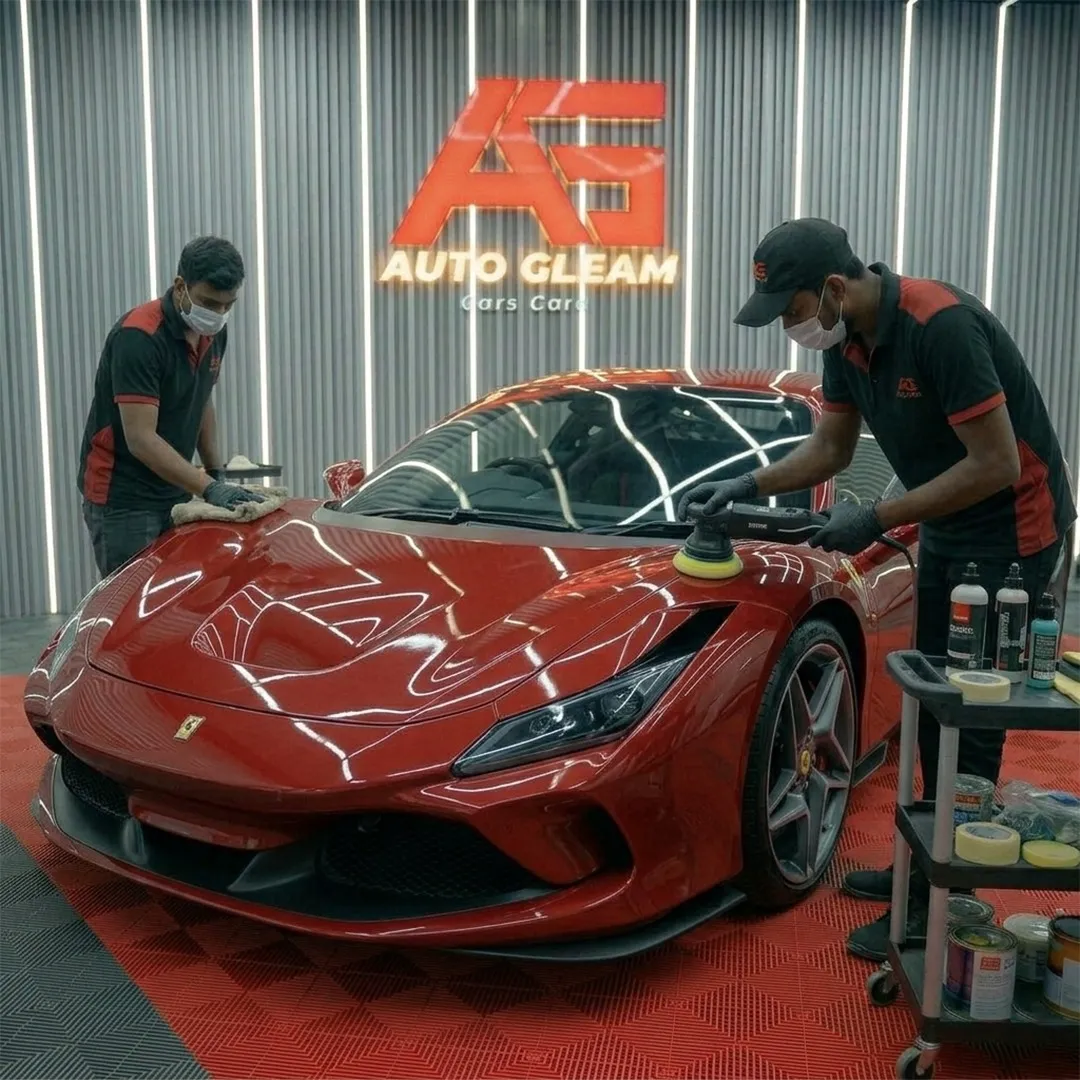
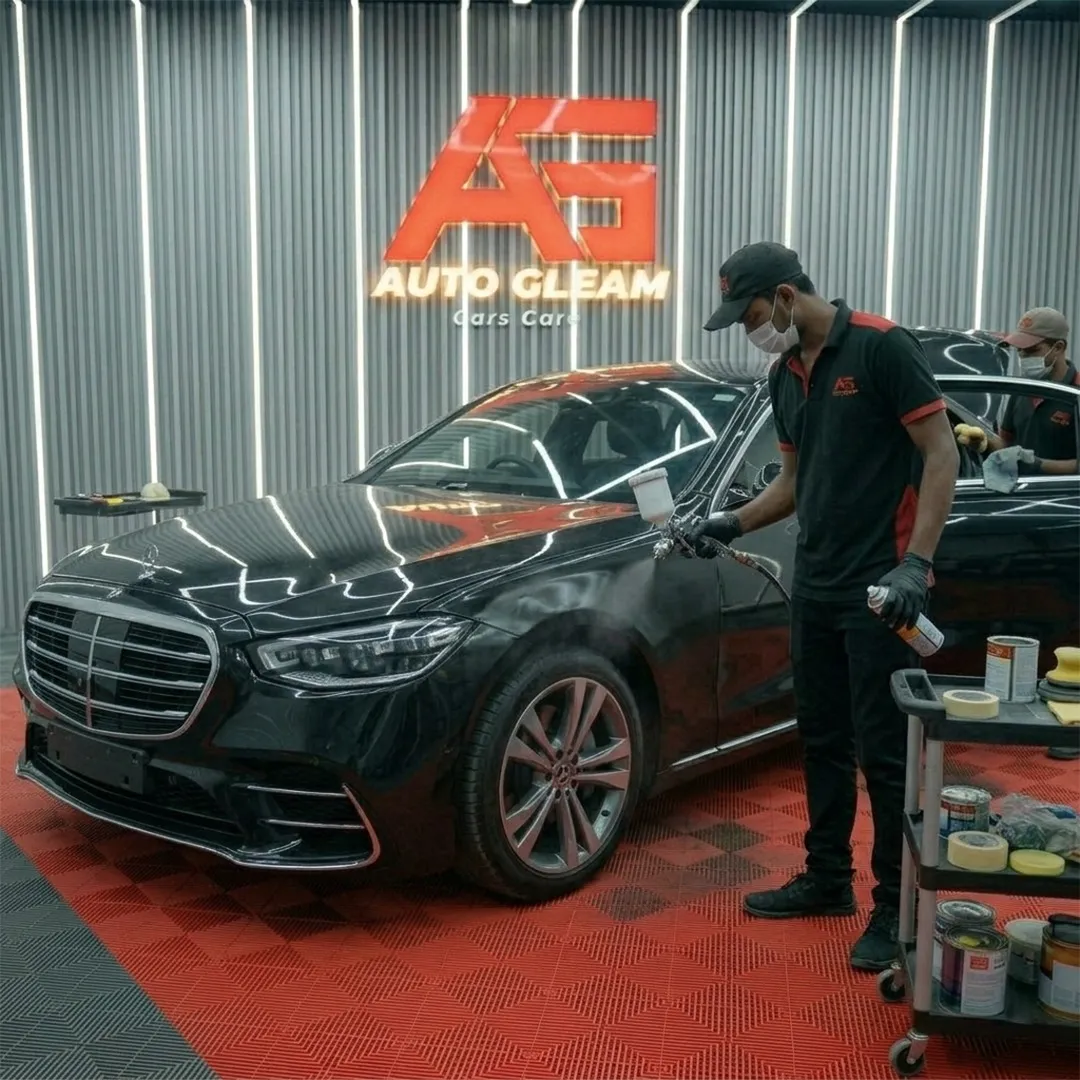
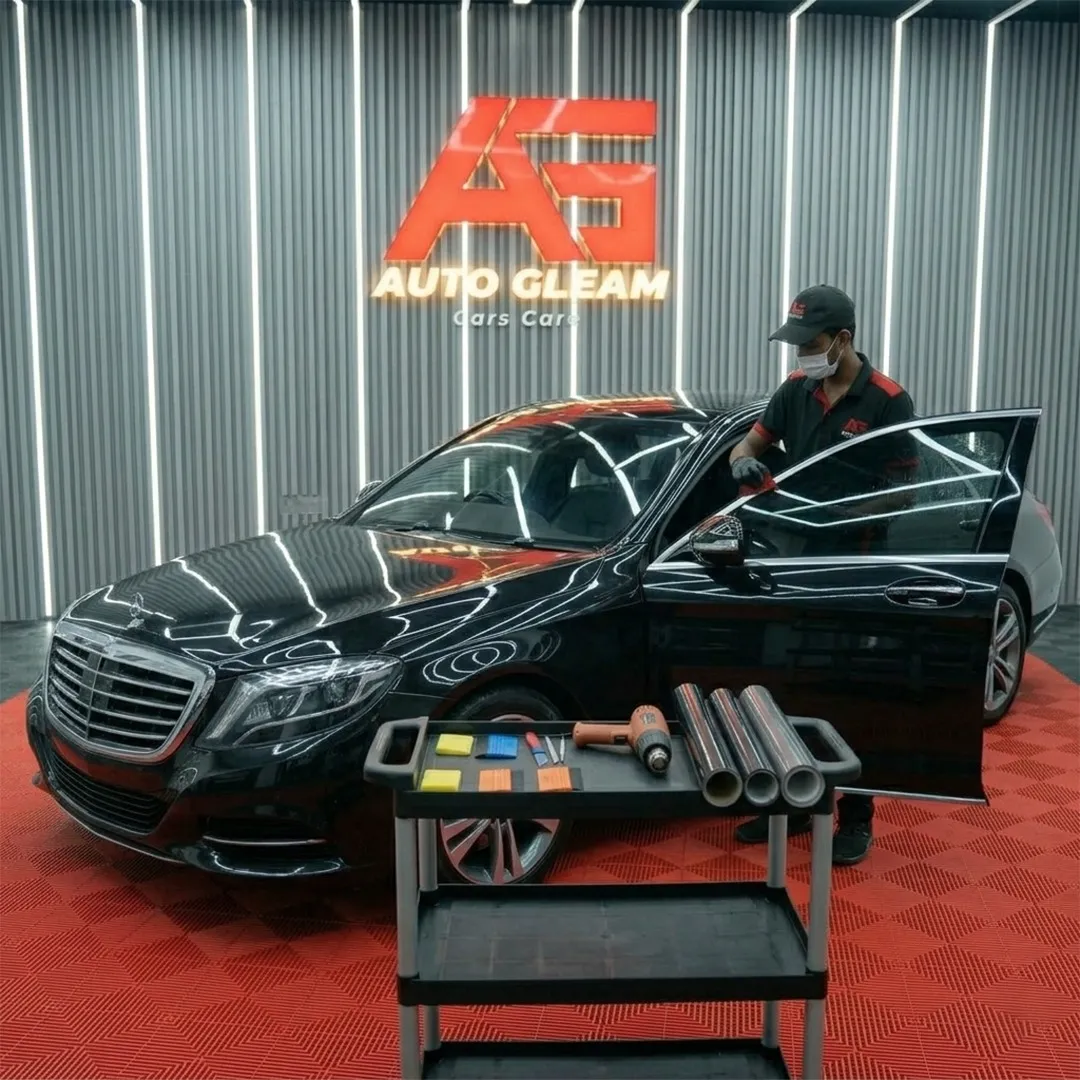
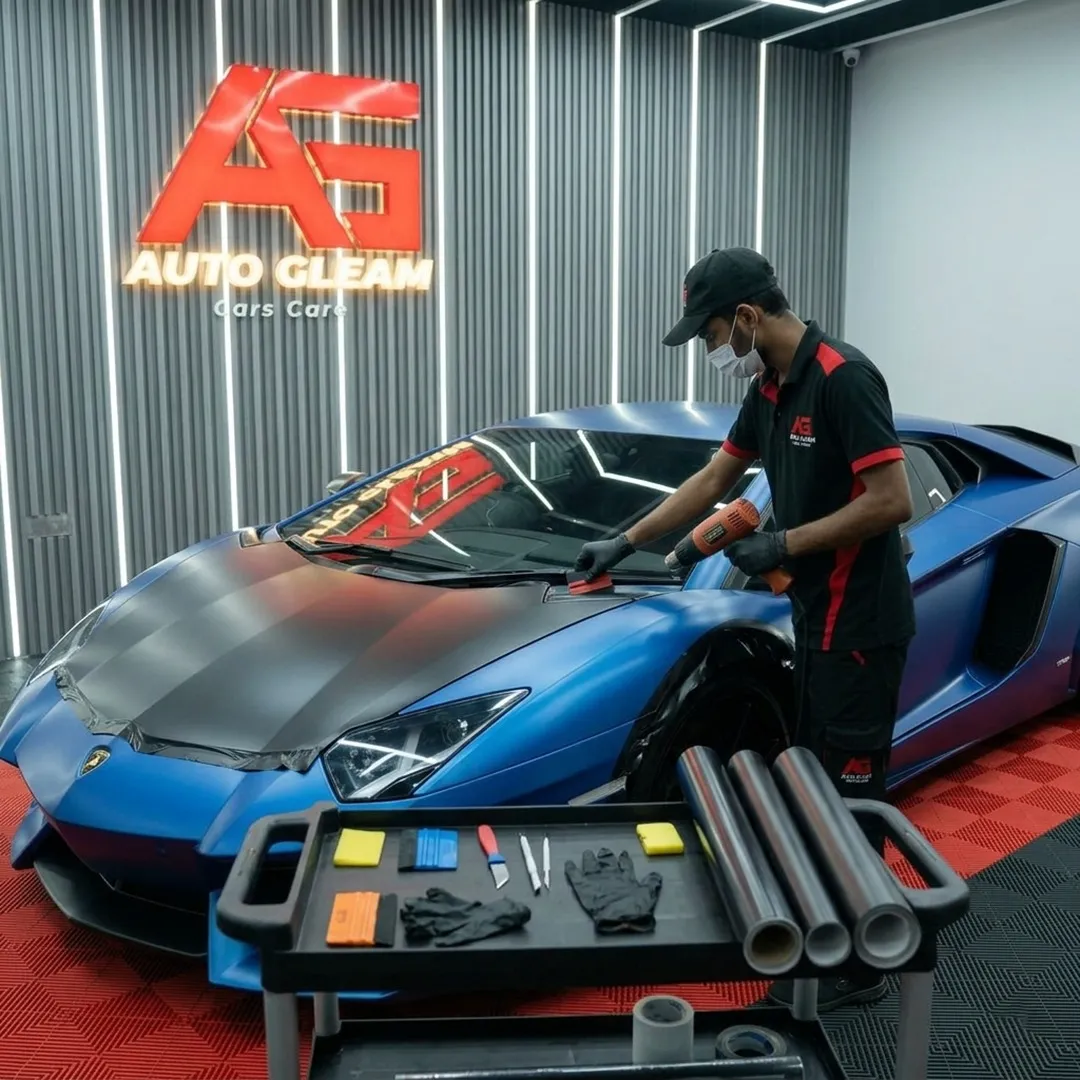
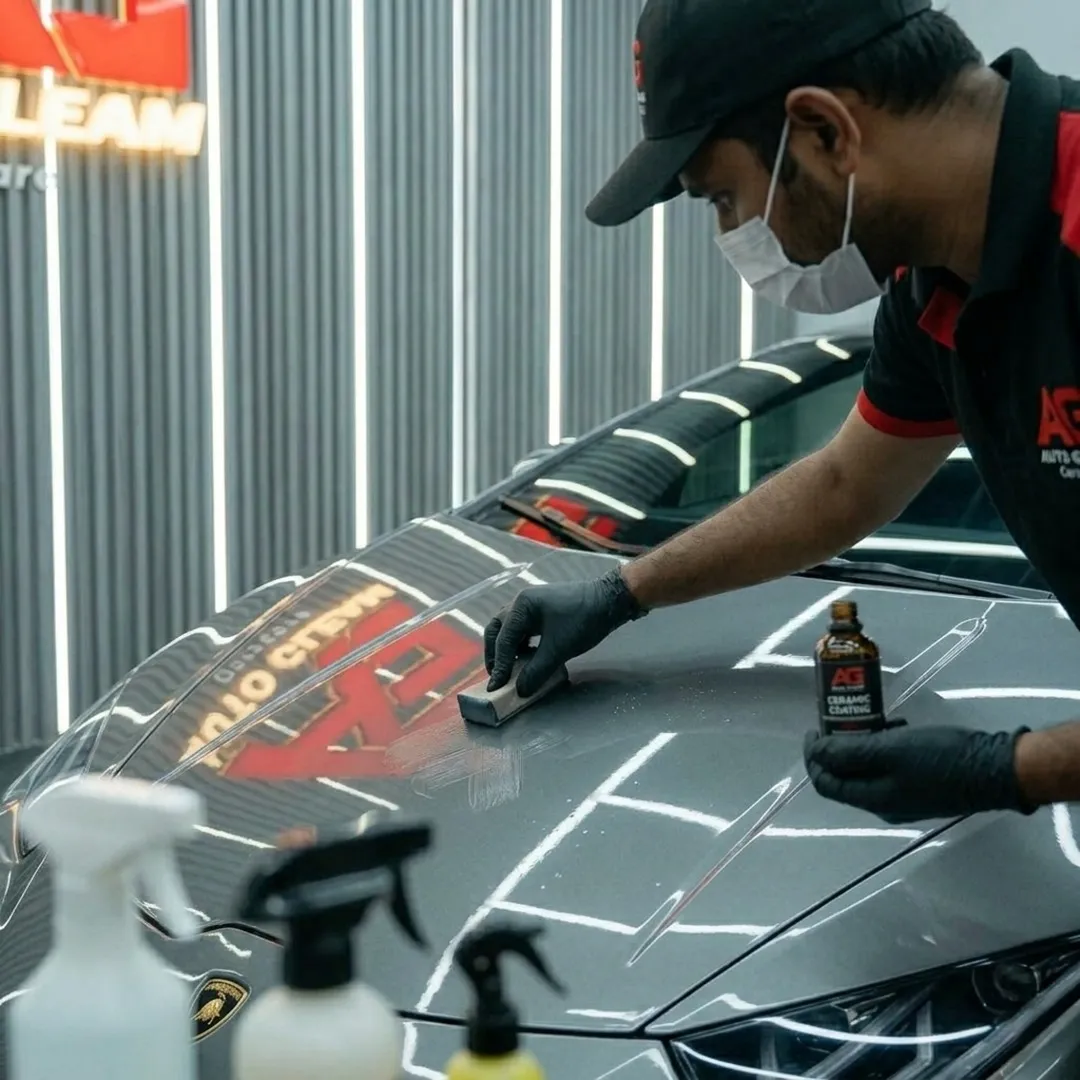
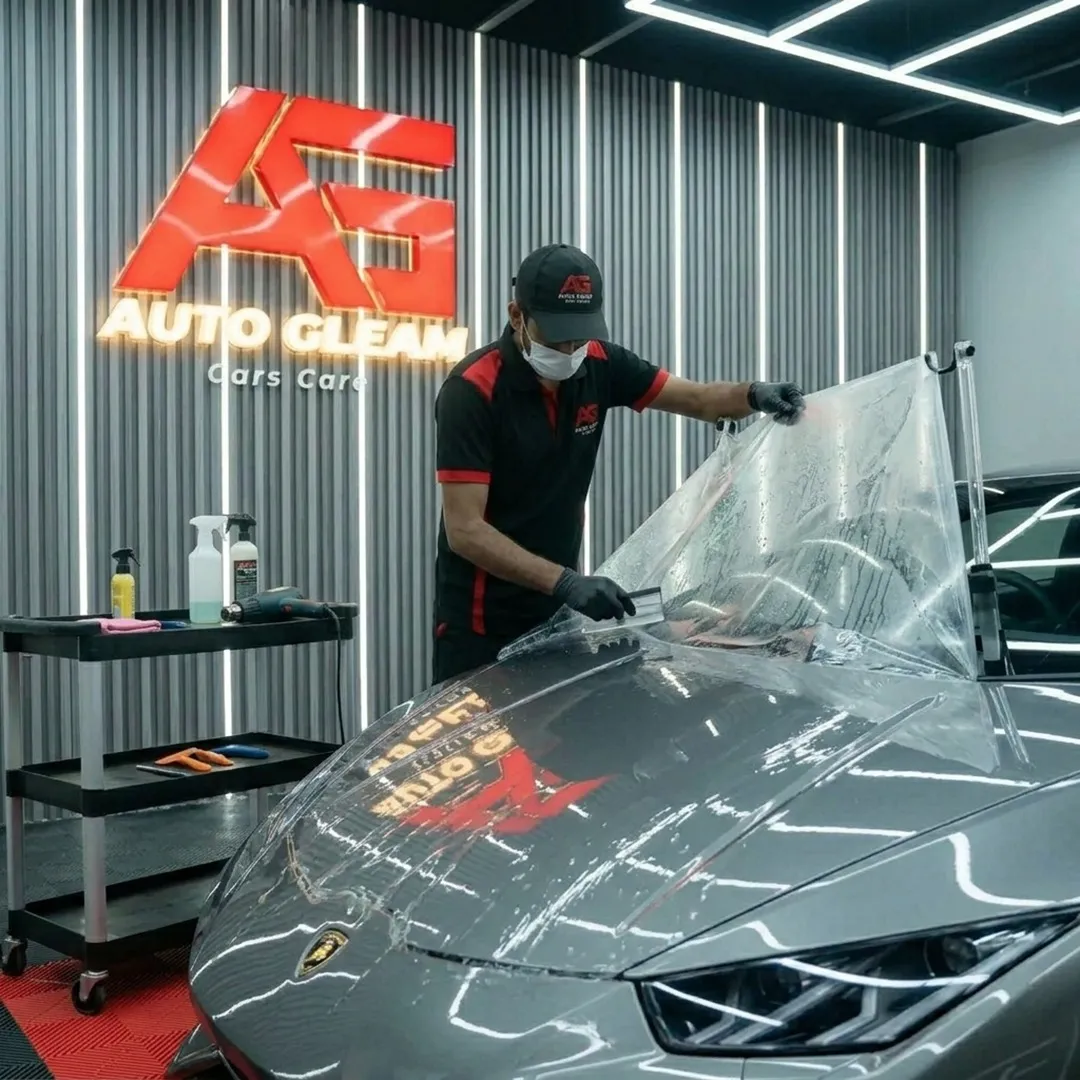
How We Install PPF
Our PPF Process
Step 01
Book Appointment
Call or WhatsApp us to schedule your visit. We confirm a time that works for you.
Step 02
Paint Inspection
We measure paint thickness and inspect every panel to identify defects that must be corrected before film is applied.
Step 03
Surface Preparation
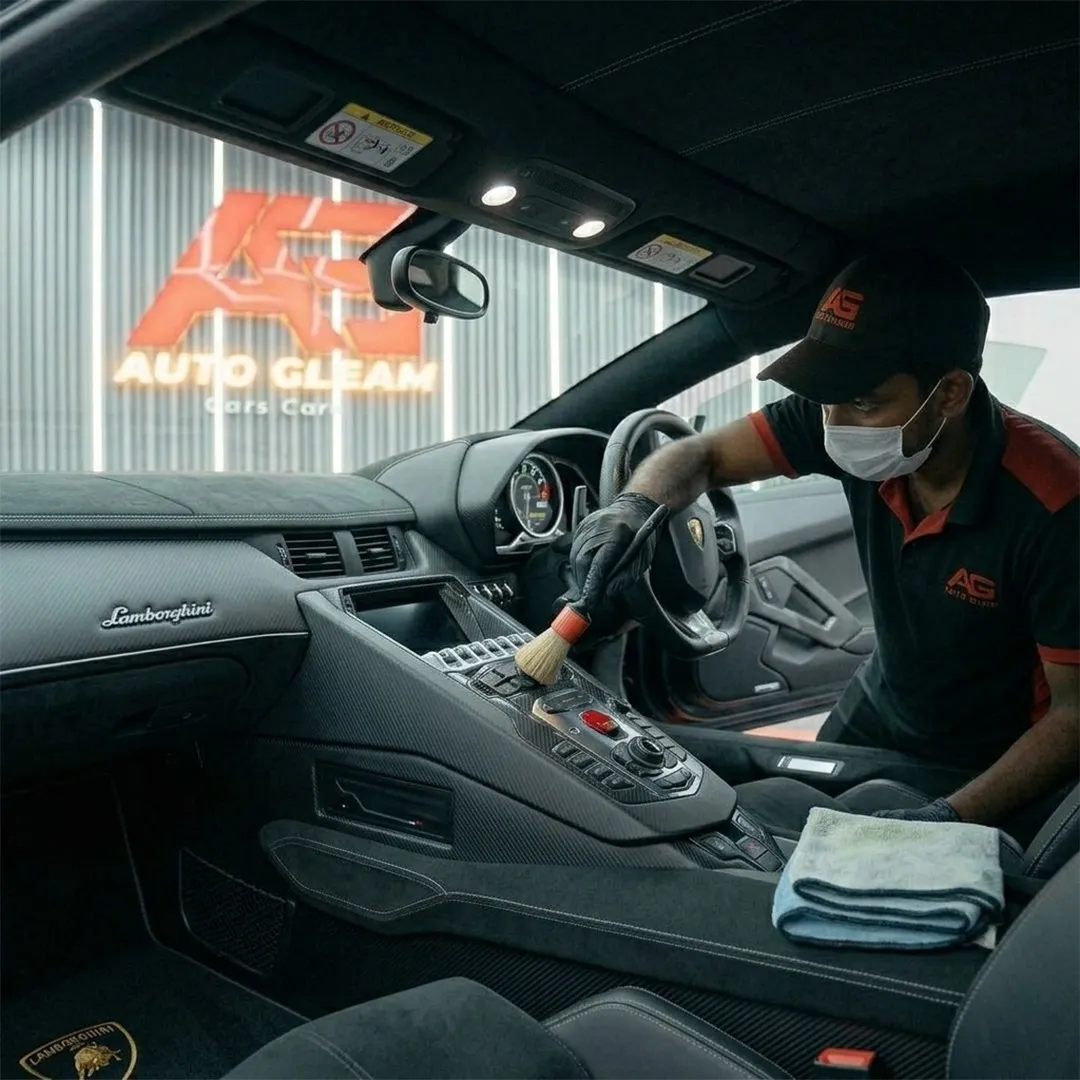
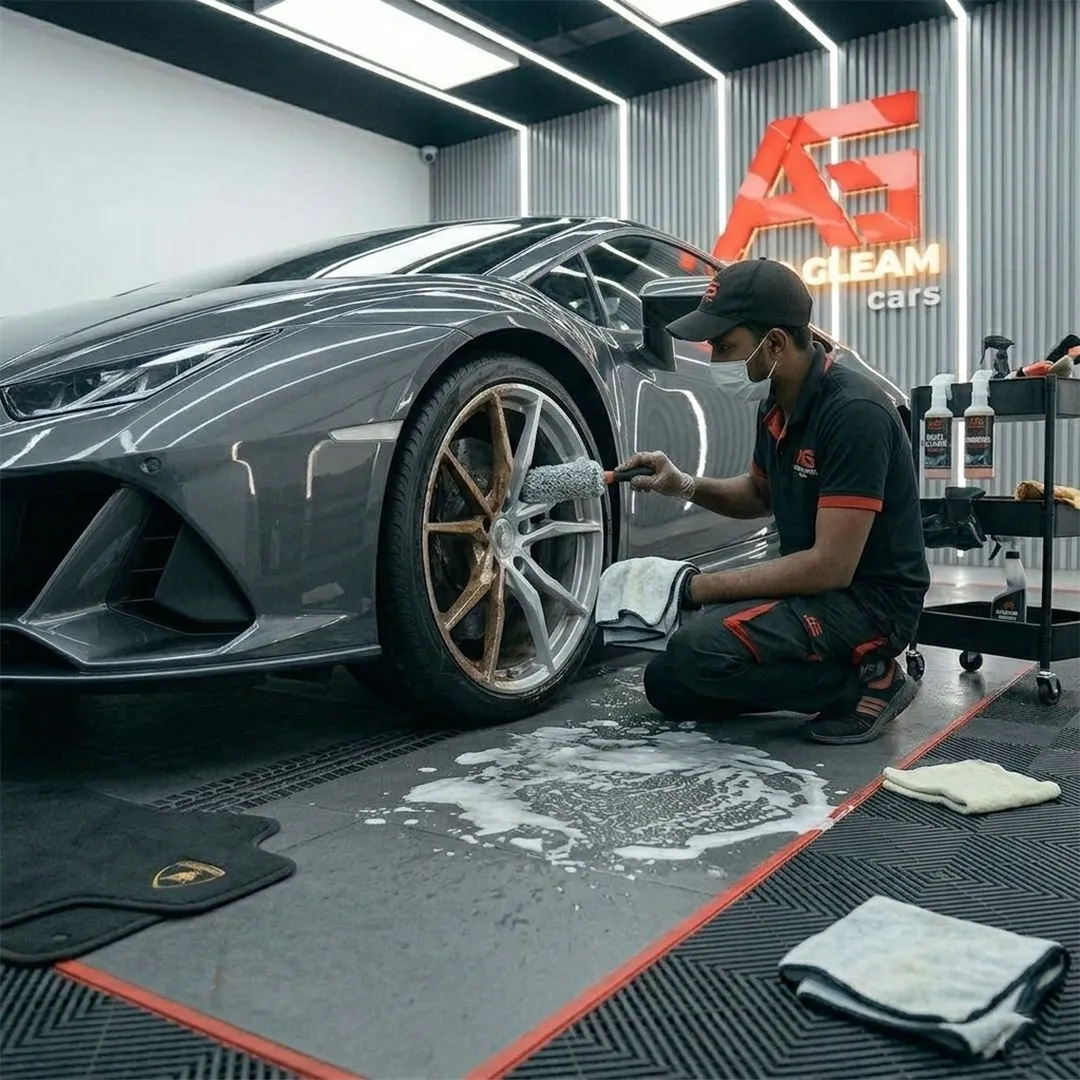
Full foam wash, clay bar decontamination and IPA panel wipe-down ensures the film bonds with zero lifting or bubbles.
Step 04
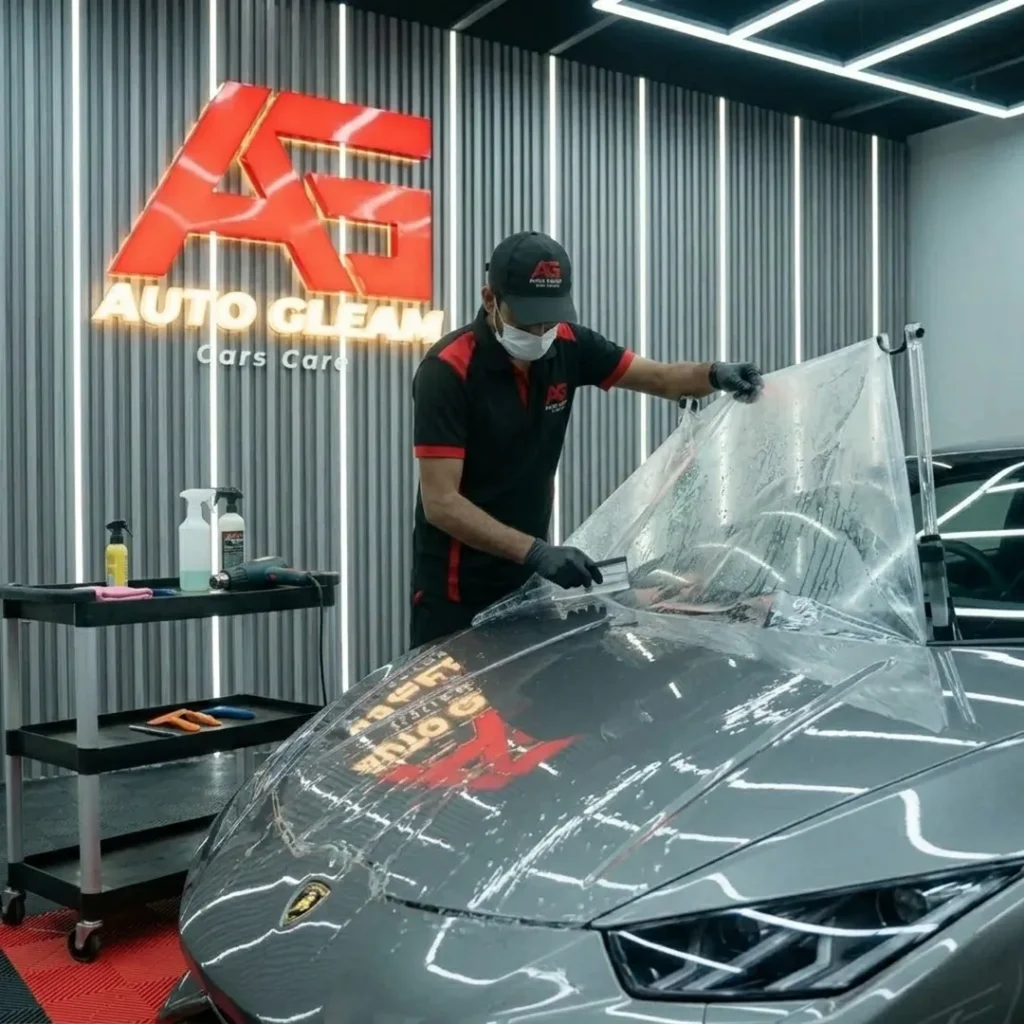
Film Cut & Apply
Computer-plotted PPF is precision-cut for your exact model, then applied panel by panel with a slip solution for a perfect, invisible fit.
Step 05
Seal & Deliver
All edges are heat-sealed for a seamless finish. After curing, your car leaves with invisible, long-term paint protection.
PPF Installation in Dubai Marina — A Complete Guide for the World’s Most Salt-Intensive Automotive Environment
Dubai Marina is extraordinary urban engineering. A 3-kilometre artificial canal carved directly from the Arabian Gulf, surrounded by over 200 residential towers, 70,000 residents, 8 kilometres of waterfront promenades, and a nightlife and restaurant ecosystem that generates more valet parking volume per square kilometre than almost anywhere in Dubai. It is also, from a car paint deterioration perspective, one of the most demanding environments in the city.
The canal is not decorative. It is actively connected to the Arabian Gulf. The saltwater it contains generates marine aerosols continuously. The wind between Dubai Marina’s towers — which run north to south in a configuration that channels sea breeze from the Gulf directly through the residential corridors — concentrates that salt air and delivers it to every vehicle surface within the community. Combined with the underground multi-level parking garages that are the primary parking environment for most Marina residents, the weekend valet congestion at the Walk and Marina Mall, and the daily Sheikh Zayed Road commute, Dubai Marina produces a specific combination of paint threats that warrants its own complete analysis.
At AutoGleam Car Care LLC, we have been installing Paint Protection Film on Dubai Marina vehicles for over 10 years. This blog is the honest summary of what that experience has revealed about this specific community and what Paint Protection Film does for the vehicles that live here. Message us on WhatsApp when you are ready to book — and read on if you want to understand why your Marina vehicle needs protection more than you might think.
Why Dubai Marina Is One of the Most Demanding Environments for Car Paint
Every Dubai community has paint threats. Dubai Marina has a combination that is specific to its engineering, its geography, and its lifestyle character. Understanding each one explains the PPF conversation for Marina residents specifically.
The Canal — A 3-Kilometre Saltwater System in the Middle of Your Neighbourhood
Dubai Marina was not built beside the sea — the sea was brought into it. When the artificial canal was constructed, seawater from the Arabian Gulf was channelled directly inland to create the marina. This means Dubai Marina’s canal water is genuine seawater — high in sodium chloride, magnesium, and marine biological content — not treated or freshwater-filled recreational water. The canal runs 3 kilometres through the heart of the residential community, bordered on both sides by residential towers, the Marina Walk promenade, restaurants, and parking areas.
Saltwater evaporates continuously from the canal surface. In Dubai’s heat, this evaporation rate is significant — warm water evaporates faster than cool water, and the marina’s canal temperature in summer reaches levels that produce consistent evaporation throughout the day. The water vapour that rises carries with it dissolved salt compounds — sodium chloride aerosols that remain suspended in the air and deposit on every surface they contact. For vehicles in Dubai Marina, this means continuous salt deposition from a direct seawater source running metres from where the vehicles park, drive, and sit. This is qualitatively different from the ambient sea-breeze salt exposure in communities like Jumeirah or the Marina’s own coastal fringe — it is a constant, localised marine environment in the middle of a residential neighbourhood.
The Wind Tunnel Effect — How Tower Architecture Concentrates Salt Air
Dubai Marina’s towers are configured in a layout that, by accident of the community’s phased development, creates significant wind channelling through the residential corridors. When Gulf breezes approach the community from the west, they are funnelled between the towers — which act as walls directing and accelerating the airflow through the gaps between them. The residential streets at ground level and the canal-facing parking areas experience higher wind velocities than the community’s overall exposure position would suggest.
This wind channelling carries the salt aerosols from the canal — and from the Arabian Gulf directly, which the marina opens onto to the west — through the residential corridors at accelerated velocity. Vehicles parked on the streets along the canal, in the waterfront car parks, and in the exposed sections of tower podium parking experience higher salt deposition than a comparable distance from the coast would produce in a more open coastal community like Jumeirah. The tower corridors are, effectively, salt air concentrators that give Marina vehicles a marine exposure profile more intense than their geographical distance from the sea would imply.
Underground Parking Garages — The Damage Closest to Home
Most Dubai Marina residents park in their building’s underground multi-level parking garage. Princess Tower alone has six underground parking levels accommodating nearly 1,000 vehicles. This underground parking arrangement is the single most common source of contact damage on Marina vehicles — closer than the marina’s road network, more frequent than any other paint damage mechanism.
Underground garages in Dubai Marina’s residential towers are characterised by: tight turning radii at level transitions (the ramps and turns required to move between levels), painted concrete pillars that vehicles brush against during parking manoeuvres, narrow bays that require multiple adjustment moves to enter and exit, low ceilings that roof box or antenna attachments contact, and high vehicle density — meaning other drivers’ doors open into adjacent vehicles’ panels during the time the cars are parked between journeys. The aggregate of door dings from adjacent parkers, pillar brushes during manoeuvring, and low-speed contact incidents in tight underground conditions makes Dubai Marina’s underground parking environment one of the most prolific generators of vehicle contact damage in the city. PPF on door panels, sills, door edge guards, and bumpers absorbs this contact in place of the paint.
Sheikh Zayed Road at Interchange 5 — The Stone Chip Corridor
Dubai Marina’s primary motorway access is at Interchange 5 of Sheikh Zayed Road — one of the UAE’s most heavily trafficked motorway junctions. The Al Sufouh Road and Jumeirah Beach Road connections, the Dubai Internet City and Media City access, and the high volumes of commercial vehicle traffic on this section of Sheikh Zayed Road create a junction where stone chip exposure is consistent and significant.
Marina residents who commute via Sheikh Zayed Road — to Downtown, DIFC, Business Bay, or south toward Abu Dhabi — travel this interchange twice daily. The truck and construction vehicle traffic that uses Sheikh Zayed Road through the Dubai Marina and JBR corridor, servicing the ongoing development in this zone, deposits road debris that vehicles following at highway speed collect on their front ends. The bonnet and front bumper of a Dubai Marina resident’s daily commuter vehicle accumulates stone chip damage from this corridor at a predictable rate — one to two years without PPF produces visible chip pitting on the leading surfaces of any vehicle that commutes via this route.
The Marina’s Evening Economy — Valet Parking at the Highest Volume in Dubai
Dubai Marina’s restaurant, hotel, and nightlife ecosystem along the Marina Walk, JBR’s The Walk, and the surrounding hospitality strip generates more valet parking activity in the evening hours than almost anywhere in Dubai. The Westin, Address, Grosvenor House, JW Marriott, and the dozens of high-end restaurants and beach clubs along the promenade all use valet services — and Thursday and Friday evenings in Dubai Marina see valet volumes that produce the conditions for paint incidents as a matter of statistical certainty.
Valet attendants managing multiple vehicles simultaneously in crowded drop-off zones, reversing luxury cars into tight temporary parking positions, manoeuvring through crowded car parks alongside other valets doing the same — the probability of contact incidents in this environment is meaningful. The Marine’s valet volumes also mean that vehicle attendants handle hundreds of different vehicle types through an evening — the familiarity with any specific vehicle that reduces incident risk is absent. Door panel coverage, rear bumper protection, and mirror coverage specifically address the valet-incident damage pattern that is common on Marina vehicles used for the community’s restaurant and nightlife economy.
JBR Beach Sand — Wind-Carried Across the Marina District
Dubai Marina borders JBR — Jumeirah Beach Residence — and its public beach directly to the west. The beach is one of Dubai’s most heavily used coastal public spaces, and the fine Gulf sand from the beach is lifted and transported by the prevailing western breezes across JBR and into the Marina district. Vehicles in Dubai Marina accumulate beach sand on their surfaces even without going anywhere near the beach — the wind brings the sand to them.
This beach sand is extremely fine — finer than the inland desert sand that accumulates on vehicles in Jumeirah, Arabian Ranches, or Mirdif. Its light particle size means it stays suspended in the air at lower wind velocities and travels further from its source. When it settles on painted surfaces, it creates abrasion with every gust that moves it across the surface. For Marina vehicles that park outdoors or in open podium parking, beach sand abrasion is a continuous, low-energy surface deterioration mechanism that accumulates into the swirl mark haze visible on unprotected vehicles in the community.
The Real Cost of Unprotected Paint on a Dubai Marina Vehicle
The case for PPF in Dubai Marina is not just about aesthetics — it is about the financial mathematics of vehicle ownership in a high-marine, high-contact-risk environment.
What 3–4 Years of Unprotected Marina Exposure Looks Like on Luxury Paint
A vehicle purchased new and left unprotected in Dubai Marina for 3–4 years typically accumulates: stone chip pitting on the bonnet and front bumper from Sheikh Zayed Road commuting (15–30 chips on the bonnet is typical for a regular highway commuter), swirl marks across all panels from washing in hard water and from the fine beach sand that settles on the surface between washes, door dings on both door panels from underground garage adjacent parking, possible early oxidation on roof and horizontal surfaces from the combination of UV and salt air, and paint fade on the most UV-exposed surfaces.
The paint correction cost to address this deterioration before resale or before PPF application at this stage — polishing, touch-up, and decontamination — typically runs AED 2,000–5,000 on a standard luxury sedan, and more on complex exotic paint systems. At resale, buyers who assess the paint condition with a gauge and inspection lighting calculate their offer accordingly, deducting estimated reconditioning cost plus a premium for their trouble. The net impact on resale offers for an unprotected 4-year-old luxury vehicle from Dubai Marina versus the same vehicle with PPF-protected factory paint is consistently AED 5,000–12,000.
The Underground Garage Factor — Why Marina Contact Damage Is Higher Than Average
For vehicles in other parts of Dubai, parking contact incidents in tight spaces are occasional. For Dubai Marina vehicles in residential tower garages, they are frequent. The tight multi-level underground garages that characterise Marina residential buildings are significantly more contact-prone than the surface-level or multi-storey open car parks in less densely built communities. Over a 3–5 year period, a Marina vehicle in underground tower parking accumulates door dings, pillar brushes, and low-speed contact marks at a substantially higher rate than a vehicle parking in a less constrained environment. PPF on door panels and sills absorbs this contact — turning what would be paint-through scratches into self-healing film surface marks.
PPF Coverage That Makes Specific Sense for Dubai Marina Vehicles
Dubai Marina’s specific damage profile points to specific coverage priorities. Here is how we think about coverage for vehicles in this community.
Full Body PPF — The Comprehensive Answer to the Marine Environment
For new, high-value vehicles based in Dubai Marina, full body coverage is the most comprehensive response to the community’s combination of threats. Every panel sealed against salt air contact, beach sand abrasion, UV radiation, and physical contact. For Bentley, Porsche, Range Rover, Mercedes-AMG, and similar value vehicles in the Marina’s residential mix, full body PPF addresses the canal-proximity corrosion risk that other communities do not face at the same intensity. When the film is removed after its 7–10 year service life, the paint underneath has been completely isolated from the salt environment that has been acting on the film surface throughout the ownership period. That is not a minor benefit in Dubai Marina — it is the difference between factory-condition resale paint and paint that has been under sustained marine atmospheric attack.
Front Protection Plus Door and Side Coverage — The Marina-Specific Package
For Marina residents who want targeted coverage addressing the community’s primary damage mechanisms: a comprehensive front protection package (full bonnet, front bumper, front wings, mirrors, headlights) combined with full door panel coverage on all doors and sill coverage. This combination addresses the two primary paint damage sources in Dubai Marina — road stone chips on the front from the Sheikh Zayed Road commute, and contact damage on the door panels from the tight underground garage environment. This is the most common coverage configuration we recommend specifically for Marina residents because it directly addresses the two highest-probability damage mechanisms in this community.
Marine-Priority Coverage — Addressing Salt Air Specifically
For vehicles in the most canal-adjacent buildings — those directly on the Marina Walk, the waterfront tower frontages, or the Yacht Club area — the salt air exposure is highest and edge termination coverage (sills, lower panel edges) is particularly important. Salt air-driven corrosion initiates at paint edges and vulnerabilities. Ensuring that all panel edges are properly film-covered, with film tucked under panel edges wherever design allows, is the specific coverage priority for the most marine-exposed vehicles in the community. We discuss specific coverage for each vehicle’s exact parking location when consulting with canal-facing tower residents.
Rear Coverage — The Valet Parking Addition for Marina Night Economy Users
For Marina residents who regularly use valet parking at the Walk’s restaurants and hotels, adding rear bumper and boot lid coverage to the standard front-plus-door package addresses the second most common valet incident damage location. Rear bumpers take contact from valets reversing in tight temporary parking positions and from other valets’ vehicles manoeuvring in the same confined space. A small addition to the coverage scope eliminates the need to assess and absorb rear bumper repair costs from the evening dining and nightlife economy that is central to Marina’s residential lifestyle.
PPF Film Brands and Marine Environment Performance
The marine environment of Dubai Marina makes film selection more specific than in inland communities. Salt air, humidity from the canal, and the combination of UV and moisture cycling create a demanding adhesive performance environment.
XPEL Ultimate Plus and Ultimate Fusion — The Marine Performance Benchmark
XPEL films have the most comprehensive UAE market history and the best UV stabiliser performance that has been validated through UAE conditions over the longest track record. XPEL Ultimate Fusion’s ceramic-infused top coat provides inherent hydrophobic properties — salt air deposits bead and roll off more completely during washing, reducing the mineral deposit accumulation that is a specific concern in humid, salt-rich environments like the Dubai Marina waterfront. The XPEL warranty covers yellowing, delamination, and adhesive failure specifically — adhesive performance in Dubai Marina’s environment, with its salt moisture component, is best served by a warranted product from a brand that has validated its adhesive chemistry in UAE conditions over time.
3M Scotchgard Pro Series — The Low-Surface-Energy Option
3M Scotchgard Pro Series has the lowest surface energy of the major PPF brands — meaning contamination, including salt particles and marine aerosols, bonds minimally to the film surface. For Dubai Marina’s continuous salt deposition environment, low surface energy is a practical performance advantage: the film stays cleaner between washes because contamination adhesion is minimised, and salt deposits rinse off more completely with each wash cycle. For canal-adjacent vehicles that accumulate heavy salt deposition quickly, 3M’s surface energy properties make maintenance meaningfully easier.
SunTek and LLumar — Strong Marine Adhesive Performance
SunTek’s adhesive systems are noted for their performance in humid and marine environments — the adhesive chemistry maintains bonding strength through temperature and humidity cycling. For Dubai Marina’s combination of canal humidity and temperature extremes, SunTek’s adhesive stability is a relevant practical advantage. LLumar provides similar Eastman Chemical engineering with good UAE market warranty support. Both are premium, properly warranted options appropriate for Dubai Marina’s environment.
What “Premium” Installation Means for Marina Vehicles — The Process
Dubai Marina vehicles coming to AutoGleam for PPF receive the same meticulous process that every installation does — and the specific aspects of that process that matter most for the marine environment are worth understanding.
Salt Decontamination Before Application
For vehicles from Dubai Marina’s most canal-adjacent buildings, we perform a specific salt decontamination assessment before standard preparation. Salt deposits on the paint surface before PPF application would be trapped under the film’s adhesive — concentrated salt in contact with the clear coat permanently and hidden from future cleaning. Our decontamination wash and clay bar process addresses this, but for vehicles from the most marine-exposed parking situations, we take additional care in the decontamination stage to ensure the surface is fully clean before film adhesion begins.
Edge Wrapping — Critical for Marine Environment Adhesion
In a salt air environment, any film edge that is not properly sealed is a potential salt ingress point. Salt-carrying moisture that wicks under an unsealed film edge, particularly on horizontal surfaces where water pools, can accelerate adhesive degradation and edge lifting. Our edge wrapping technique — tucking film under panel edges wherever design permits — seals the termination point completely, eliminating the edge ingress risk. This technique takes more time and skill than leaving edges cut on the panel surface, but for Dubai Marina vehicles, it is the correct approach for long-term adhesion in the marine environment.
Climate-Controlled Application Bay
Dubai Marina’s ambient air — particularly near the canal waterfront — carries elevated humidity from the water evaporation and higher concentrations of airborne marine particulates than inland areas. Professional PPF installation requires an enclosed, climate-controlled application bay regardless of location, but the contamination concentration in Marina’s environment makes our enclosed bay even more specifically necessary than for inland installations. Film applied in an open or non-controlled environment near the canal would be exposed to both dust and marine particulate contamination in the adhesive during application — the film may look fine immediately after installation and then show progressive adhesion issues as the trapped contamination affects the bond.
AutoGleam Al Quoz — The Right Workshop for Dubai Marina Vehicles
From Dubai Marina, our Al Quoz workshop is 15–20 minutes on Sheikh Zayed Road — a direct, simple drive that most Marina residents make routinely for other purposes. The workshop is located in the direction of most Marina residents’ daily commutes, meaning dropping the car off on the way in and collecting on the way back is logistically convenient for many customers.
Al Quoz provides the controlled workshop environment that Dubai Marina’s canal-adjacent ambient conditions make particularly important. Our enclosed installation bay, climate management, and dust-controlled application space produce results that an outdoor or open installation environment near the marina could not — regardless of the installer’s skill level. The physics of dust and salt particle contamination in open-air installation are unavoidable. Our workshop environment addresses them.
Complete Auto Care Services at AutoGleam for Dubai Marina Customers
- PPF Installation Dubai — full body and partial coverage, premium brands, all vehicle types
- Ceramic Coating Dubai — SiO₂ and graphene coating for UV and chemical protection in marina environments
- Car Detailing Dubai — full interior and exterior detailing with marine salt decontamination
- Car Polishing Dubai — paint correction before PPF and standalone swirl mark removal
- Car Window Tinting Dubai — UV/heat rejection tinting for interior protection alongside exterior PPF
- Car Interior Cleaning Dubai — deep cleaning, steam sanitisation, and leather conditioning
- Car Wrapping Dubai — vinyl colour-change and protective wrapping
- Car Denting & Painting Dubai — bodywork repair and panel repainting
- Paintless Dent Removal (PDR) Dubai — dent repair without repainting on undamaged paint
- Wheel Rim Refurbishment Dubai — alloy wheel restoration and refinishing
40 Questions About PPF Installation in Dubai Marina — The Complete Answers
Dubai Marina-Specific Questions
1. Does living next to Dubai Marina’s canal actually accelerate car paint corrosion?
Yes — and more significantly than most Marina residents realise. Dubai Marina’s canal is directly connected to the Arabian Gulf, making it genuine seawater rather than treated water. Seawater evaporates continuously from the canal surface, particularly in Dubai’s heat, releasing sodium chloride aerosols into the surrounding air. Vehicles parked in the immediate vicinity of the canal — the waterfront buildings on Marina Walk, the canal-facing podium parking areas — are exposed to substantially higher salt deposition than buildings set back further from the water. Salt deposits on paint accelerate corrosion at any point where the paint is compromised: a stone chip, a scratch, a parking contact mark. In Dubai Marina, these damage points become corrosion initiation sites within months rather than the years it takes in inland communities.
2. How does the wind between Dubai Marina’s towers affect car paint?
Dubai Marina’s tower configuration creates wind channelling that concentrates and accelerates the Gulf sea breeze between the residential corridors. Vehicles parked on the ground-level streets along the canal and in podium parking areas are exposed to higher wind velocities than the open coastal position would predict, because the towers funnel the wind into the gaps between them. This channelled wind carries both the salt aerosols from the canal and the fine beach sand from JBR at elevated velocity. The combined effect is faster deposition of corrosive and abrasive particles on vehicles in the Marina corridors compared to vehicles in less architecturally concentrated coastal communities.
3. Underground parking garages in Dubai Marina towers — what specific damage patterns do they create?
Multi-level underground parking in Dubai Marina’s residential towers creates three primary damage patterns. Contact on door panels from adjacent vehicles’ doors opening in tight bays during parking — this generates the door ding damage that accumulates across both door panels over years of use in the same garage. Pillar brushes — contact between the vehicle’s front and rear corners, bumpers, or door mirrors and the concrete pillars that are unavoidable in tight multi-level underground garages — generating paint scratches at specific repetitive contact points. And roof or antenna contact with low overhead obstructions at ramp transitions and level changes. PPF on door panels (the highest frequency damage location), door edges, door mirrors, and front and rear bumpers directly addresses the most common underground garage damage mechanisms.
4. JBR beach is next to Dubai Marina — does beach sand reach Marina vehicles?
Yes. JBR’s public beach is immediately west of Dubai Marina, and the prevailing Gulf breeze that typically comes from the west carries beach sand from JBR eastward into the Marina district. Gulf beach sand is finer and lighter than inland desert sand — it stays suspended in air at lower wind speeds and travels further from its source. Marina vehicles accumulate fine beach sand even without travelling to the beach or parking near it. This sand is abrasive on paint surfaces — individual particles are small but their cumulative impact, multiplied by thousands of particles depositing and moving across the paint surface in each wind event, creates the fine surface abrasion that produces swirl marks and haze over time. PPF absorbs this abrasion continuously, leaving the paint surface unaffected.
5. How many stone chips does a Dubai Marina resident typically accumulate per year from Sheikh Zayed Road commuting?
We cannot give a precise number — it depends on specific route, following distance, time of day, and what vehicles are ahead. From our experience inspecting Dubai Marina vehicles that commute via Sheikh Zayed Road from Interchange 5: vehicles doing daily round-trip commuting on this section over one year typically present with 8–20 stone chip impacts on the bonnet, concentrated on the leading third of the bonnet that faces the preceding vehicle’s tyre-thrown debris. Over three years, this accumulation produces visible chip pitting that is not simply an aesthetic issue — each chip exposes bare metal to Dubai Marina’s salt air, and rust initiation at these points begins within months in the marine environment. Front protection PPF prevents every one of these chips from reaching the paint.
6. Which Dubai Marina buildings have the tightest parking garages — and does it matter for PPF?
Marina’s older residential towers from the 2005–2012 development phase — many of the original towers along the canal — have underground garages that were designed to UAE parking standards of the time, which are tighter than contemporary standards. Newer developments in the Marina and adjacent areas have somewhat more generous bay widths and turning radii. The practical implication: if your building’s garage requires significant manoeuvring to enter and exit your bay, you are in a higher contact-risk environment. We advise on coverage priorities based on each customer’s specific parking situation — the underground garage tightness and configuration is one of the factors we ask about during PPF consultation for Marina residents.
7. Does the Dubai Marina yacht community face specific paint threats from yacht maintenance activities?
Vehicles parked near the Marina Yacht Club, the Yacht Club car parks, and the berth-side areas are exposed to an additional source of chemical contamination: antifouling paint compounds and marina maintenance chemicals used on the vessels. These are typically sprayed or applied near waterfront areas and can deposit on nearby vehicles as fine mist. Chemical contamination from antifouling compounds is particularly aggressive on automotive clear coats — it can etch clear coat significantly faster than standard environmental contamination. PPF’s chemical resistance is specifically relevant for vehicles parked in close proximity to active yacht maintenance activities in the marina berth areas.
8. Bluewater Island is very close to Dubai Marina — does the bridge route create additional PPF value?
The Bluewater Island bridge route from Dubai Marina to the island adds a small additional stone chip exposure from the road surface — the bridge expansion joints and the transition from road to bridge surface creates debris patterns slightly different from continuous road. More significantly, the bridge passes over open water, exposing vehicles to maximum salt air during the crossing with no building or terrain shelter. For Marina residents who frequently drive to Bluewater Island for Ain Dubai visits, beach access, or dining, the route adds incremental marine exposure during the bridge crossing. It is a minor additional factor, but directionally consistent with the overall argument for PPF on Dubai Marina vehicles: every element of the Marina lifestyle adds to the case.
Understanding PPF for Marine Environments
9. Does saltwater specifically degrade PPF faster than in inland communities?
Premium PPF brands — XPEL, 3M, SunTek — are engineered to resist the salt exposure that marine and coastal environments produce. Their UV stabilisers and adhesive systems are tested across diverse environmental conditions including coastal environments. When installed correctly with proper edge sealing, premium film in Dubai Marina’s environment performs to its full warranty period. The marine environment accelerates the consequences of installation shortcuts — improperly sealed edges that might eventually lift in inland conditions may lift faster with salt moisture wicking. This makes professional installation quality even more important in Dubai Marina than in inland locations, not because marine conditions degrade premium film, but because they expose any installation compromise faster.
10. Is ceramic coating over PPF especially important in a saltwater environment?
Yes. Ceramic coating applied over PPF creates a hydrophobic surface that causes the salt-laden water and marine aerosols to bead and roll off the film surface rather than dwelling and depositing. For Dubai Marina vehicles, this means the salt that continuously deposits from the canal environment is removed more completely with each wash cycle — the film stays cleaner between washes, and the mineral deposits that form when salt-laden water evaporates in the heat are reduced in frequency and severity. The maintenance benefit of ceramic over PPF is proportionate to the salt deposition rate — higher deposition environments benefit more from the hydrophobic enhancement. Dubai Marina is a high-deposition environment. The ceramic over PPF combination is particularly practical here.
11. Can PPF protect against chemical contamination from the marina environment?
Yes. PPF’s thermoplastic polyurethane construction provides chemical resistance that bare clear coat does not. The film resists acidic contamination (bird droppings, acid rain, organic acids from marine biological activity), alkaline contamination from cleaning products, and the specific chemical compounds found in marina environments including antifouling agents, diesel fuel overspray from vessel fuelling, and marine lubricants. While no film is completely impervious to prolonged exposure to aggressive chemicals, PPF’s resistance to brief contact with these compounds significantly reduces the risk of paint etching that would be permanent on unprotected clear coat.
12. How does the Dubai Marina humidity level affect PPF adhesion over time?
Dubai Marina has elevated humidity relative to inland Dubai due to the canal’s continuous water evaporation and the proximity to the open Gulf. Humidity itself does not degrade premium PPF adhesion — the adhesive systems in professional-grade films are engineered to perform across a wide humidity range. What elevated humidity does affect is the edge behaviour of improperly terminated film edges — moisture wicking under unsealed or poorly sealed edges can accelerate lifting in humid environments. Professional installation with proper edge wrapping and sealing eliminates this risk regardless of ambient humidity level. Our edge treatment for Dubai Marina vehicles accounts for the elevated humidity of the canal-side environment.
13. Does PPF protect against the unique type of water spots that form on Dubai Marina vehicles?
Dubai Marina vehicles form a distinctive type of water spot — water containing dissolved salt from the canal environment evaporates in the heat, leaving mineral deposits that are more complex than standard hard water spots. Standard hard water deposits from tap water are primarily calcium and magnesium carbonate. Marina canal water, being seawater, contains sodium chloride, magnesium chloride, potassium chloride, and various marine mineral compounds in addition to the calcium and magnesium found in hard water. These mixed mineral deposits can be more difficult to remove from bare clear coat than standard water spots. On PPF’s surface, these deposits are removed with pH-neutral decontamination products specifically formulated for film surfaces — the paint underneath is completely unaffected regardless of the deposit chemistry.
14. Is the salt air from Dubai Marina different from the sea breeze in Jumeirah?
Yes — qualitatively different. Jumeirah’s salt exposure comes from ambient sea breeze off the Arabian Gulf — wind that has travelled some distance from the waterline before reaching the vehicles in residential driveways. Dubai Marina’s salt exposure comes from direct water evaporation from the canal, which is a continuous and close-range source of salt aerosols. The concentration of salt in the air immediately adjacent to the canal is substantially higher than the ambient sea breeze concentration in Jumeirah’s residential areas set back from the Gulf shoreline. Canal-adjacent vehicles in Dubai Marina have a more intense salt exposure than Jumeirah properties that are not directly on the waterfront.
15. Can PPF be applied to a Dubai Marina vehicle that has already been affected by salt corrosion?
Existing salt corrosion — rust appearing at stone chips, edge oxidation, or paint bubbling from corrosion beneath the clear coat — must be addressed before PPF installation. The film cannot stop active corrosion that has already initiated — it seals the surface, but if rust is present under the paint, that rust continues to develop under the sealed surface. Paint correction, touch-up of affected stone chips, and in severe cases panel repair or respray must precede PPF installation. We inspect every vehicle’s paint condition thoroughly before installation and advise honestly on what remediation is needed before the film goes on. For Marina vehicles with significant existing salt-related paint damage, this preparation is a realistic requirement, not an upsell.
Coverage and Application Questions
16. What is the right PPF for a vehicle that parks on Dubai Marina Walk’s waterfront car park?
The waterfront car park positions on the Marina Walk face the canal directly — maximum salt air exposure, wind from the canal direction, and sun exposure on the canal-facing surfaces throughout the day. For a vehicle regularly parked here, full body coverage is the comprehensive recommendation. Front-facing surfaces get the highest salt deposition from prevailing west-to-east canal breeze, but all surfaces have elevated exposure in this location. Combined with ceramic coating over the PPF, this setup gives the film surface the hydrophobic maintenance benefit that reduces salt adhesion between washes. If full body PPF is not within current priorities, front-plus-door-plus-sill coverage addresses the highest-impact areas for this specific parking location.
17. Do door edge guards make sense as a standalone product for Dubai Marina underground garage users?
Yes — door edge guards are a cost-effective, targeted solution for the most specific contact damage point in underground garage parking. These are precision strips of PPF cut to protect the leading edge of each door — the exact point where door edges contact adjacent vehicles, pillars, or walls during the opening and closing movements in tight underground bays. For Marina residents who want targeted protection for their most frequent damage point without committing to full door panel coverage, door edge guards are the practical starting point. They address the number one contact damage location in Dubai Marina’s underground parking environment.
18. Can PPF be applied to the entire interior of a wheel arch to address salt spray in Dubai Marina?
Wheel arch inner surfaces receive road spray that, in Dubai Marina’s environment, contains salt-laden water from wet roads after occasional rain and from the sea air that saturates the road surface near the canal. Wheel arch liner and inner arch surface PPF is a specialised application available as an addition to standard exterior panel coverage. For vehicles in the most canal-adjacent positions that see maximum road spray salt exposure, wheel arch coverage provides corrosion protection at the inner arch surfaces and the panel edges visible inside the arch — areas where rust typically initiates on unprotected vehicles in marine environments. This is a recommendation we make for specific vehicles based on their parking situation and observed rust risk, not as standard coverage.
19. How does PPF performance on light versus dark vehicles differ in Dubai Marina?
Dark vehicles absorb more solar energy than light vehicles — surface temperatures on a black or dark navy bonnet can reach 70–75°C in Dubai Marina’s summer sun, versus 50–55°C on a white vehicle in the same conditions. This affects PPF in two ways: the adhesive experiences higher thermal stress on dark vehicles in direct sun (premium adhesives handle this; budget adhesives may soften and creep over time), and the self-healing function activates faster and more aggressively on dark vehicle surfaces where the surface temperature is higher. In Dubai Marina’s canal-adjacent locations where salt deposition is high, the surface energy maintenance of the hydrophobic coating is particularly important — we recommend ceramic coating over PPF on both dark and light vehicles, but it is proportionately more valuable on dark vehicles where the surface temperature amplifies the self-cleaning mechanism.
20. What happens to PPF if my vehicle is caught in a rare Dubai Marina rain event near the canal?
Rain near Dubai Marina carries additional contamination compared to inland rain — the water picks up salt aerosols from the canal environment as it falls, producing salt-loaded rain droplets rather than relatively clean rainwater. When this rain contacts PPF and then evaporates in the post-rain heat, it leaves salt mineral deposits on the film surface. These deposits are removed by washing with pH-neutral shampoo and, where necessary, a ceramic topper reapplication. The key point: rain in Dubai Marina is not clean freshwater rain, and allowing post-rain evaporation deposits to remain on the surface for extended periods — particularly during the rapid evaporation that follows rain in Dubai’s heat — produces mineral deposits that require specific attention. Washing the vehicle after rain, rather than leaving post-rain deposits to accumulate, is the correct maintenance practice for Dubai Marina vehicles specifically.
21. What PPF coverage addresses the specific risks of marina restaurant valet parking?
The standard valet parking damage pattern on Marina restaurant vehicles — based on our observation of vehicles presenting with specific damage profiles from this community — concentrates on: door panels (both rear and front, from adjacent vehicle door contact in tight temporary parking), rear bumper lower edge (from parking-too-close reversing), and occasionally door mirrors (from tight lane manoeuvring by unfamiliar drivers). A coverage combination addressing these specifically: full door panel coverage on all four doors, door mirror coverage, and rear bumper coverage. Combined with the front protection package that addresses the Sheikh Zayed Road stone chip risk, this provides what we describe as a comprehensive “Marina lifestyle package” — protection for both the road damage and the social occasion damage that characterise this community’s vehicle exposure profile.
22. Can the same film be applied to a vehicle that is also used for occasional off-road desert drives from the Marina?
Yes. The same premium film brands used for standard Marina road use perform appropriately on off-road desert excursions — the sand abrasion and debris impact from off-road driving is exactly the kind of physical damage PPF is designed to absorb. For vehicles doing regular off-road excursions, we discuss the coverage scope to ensure rear quarter and sill coverage is included (desert track debris comes from all directions, not just the front), and advise on inspection after particularly aggressive desert runs to check for any impact damage to the film that may need attention. The film handles both the marine environment of the Marina’s canal and the desert environment of Dubai’s off-road routes — it is a versatile protection product across Dubai’s full range of driving environments.
Maintenance Questions for Marina Vehicles
23. How often should I wash my PPF-protected vehicle given Dubai Marina’s salt environment?
More frequently than in inland communities. For canal-adjacent vehicles in Dubai Marina, washing every 5–7 days is appropriate — more often than the 10–14 day interval that works for inland Dubai vehicles with PPF. The higher salt deposition rate means salt accumulates on the film surface faster, and more frequent washing removes it before the salt concentration builds to levels that require more aggressive cleaning. A rinse with fresh water between full washes — simply hosing the vehicle down without shampoo — helps maintain the film surface between formal washes and is particularly useful after windy days when salt deposition is higher.
24. What is the best wash routine for a Dubai Marina vehicle with PPF?
Pre-rinse to remove loose salt and sand (critical — this prevents dragging abrasive particles across the film surface with the wash mitt). pH-neutral car shampoo with clean microfibre mitt and two-bucket method (one shampoo bucket, one rinse bucket). Dry with a clean, soft microfibre towel — do not allow the vehicle to air dry in the sun in a Marina canal-side location, as the evaporating hard water and salt-containing mist will deposit minerals on the surface. Apply spray ceramic topper after drying — every 2–3 washes for a Marina canal-adjacent vehicle, to maintain the hydrophobic surface that reduces salt adhesion between washes. No automated brush car washes — the brushes scratch the film surface the same way they scratch clear coat.
25. Is there any product specifically for removing salt deposits from PPF in a marina environment?
pH-neutral decontamination sprays specifically formulated for PPF-safe use are the appropriate product for removing stubborn salt mineral deposits from film surfaces. Standard hard water spot removers often contain mild acids that can affect the film’s top coat chemistry — products should be verified as PPF-safe before use. We recommend specific products at handover for Dubai Marina customers — products that are effective on the mixed mineral deposits from canal-adjacent environments and safe for the premium film’s surface. Concentrated salt deposits from significant marine exposure may require a brief dwell time before wiping — longer than standard hard water spots require.
26. How does salt air affect the self-healing function of my PPF?
Salt in the air does not specifically inhibit or accelerate the self-healing function — the healing mechanism responds to heat, not to ambient air chemistry. What salt exposure does is increase the rate at which the film surface accumulates contamination between washes, which can make fine surface marks that would otherwise heal spontaneously less visible until the vehicle is washed and the contamination layer is removed. The healing function remains active and effective throughout the film’s service life in the marina environment — it is one of the benefits that is not diminished by the environmental challenge of the location.
27. Can I use the touchless car washes near Dubai Marina Walk?
Touchless car washes — high-pressure water and foam systems without physical brushes or contact — are appropriate for PPF-protected vehicles. The main variable to check: the chemical formulation used in the wash. Some touchless systems use strongly alkaline or acidic chemicals to compensate for the lack of physical contact — these can gradually degrade the film’s top coat chemistry over time. pH-neutral or near-neutral touchless wash chemicals are compatible with PPF. If you use a touchless wash regularly, verify the chemical grade being used or ask the operator. Hand washing with pH-neutral shampoo remains the gold standard, but a quality touchless wash is a practical alternative for the frequent washing schedule appropriate for Marina vehicles.
28. Should I apply a ceramic topper more frequently because of Dubai Marina’s salt environment?
Yes. The spray ceramic topper that refreshes the film’s hydrophobic properties should be applied every 4–6 weeks for canal-adjacent vehicles in Dubai Marina — more frequently than the 2–3 month interval appropriate for inland vehicles. The higher salt deposition rate depletes the hydrophobic barrier faster, meaning the film’s easy-maintenance surface properties decline more quickly between treatments. More frequent topper application maintains the film at consistent hydrophobic performance, which is the primary maintenance tool for managing the salt deposition challenge in the Marina environment.
Technical and Comparison Questions
29. What is the difference between PPF and ceramic coating for a canal-side vehicle?
For a vehicle in Dubai Marina’s canal-adjacent environment, the roles are clearly distinct and complementary. Ceramic coating provides the hydrophobic surface that makes salt deposits bead up and roll off rather than adhering strongly — it dramatically improves the film’s maintenance behaviour in the salt environment. PPF provides the physical barrier that prevents the salt and marine contamination from reaching the paint surface — and provides impact protection against stone chips, abrasion, and contact damage. Ceramic coating on PPF is the combination that makes most practical sense for Dubai Marina: PPF for permanent paint protection, ceramic for easy maintenance of the film surface in a high-deposition environment. Neither alone matches the combined protection.
30. Does PPF affect how my car looks when parked along Marina Walk?
Premium clear PPF, professionally installed, is optically transparent — the paint colour and gloss show through completely unaltered. On a properly installed vehicle, PPF is essentially invisible. The hydrophobic surface of the film means the vehicle actually looks cleaner between washes than bare paint would — contamination beads rather than adhering. Parked along Marina Walk, a PPF-protected vehicle does not look different from an unprotected one — except that it looks cleaner and more consistently maintained, because the easy-clean surface properties reduce the haze and contamination film that builds on unprotected vehicles between washes in the marina’s salt air environment.
31. How does PPF interact with the paint of a new generation electric vehicle in Dubai Marina?
Electric vehicles in Dubai Marina — Tesla, Lucid Air, BMW iX, Porsche Taycan, Rivian — are increasingly common as the Marina’s affluent resident base adopts EVs. PPF application on EVs follows the same principles as combustion vehicles: the paint protection chemistry is identical, the preparation process is the same, and the protection performance is equivalent. Some EVs have unique body features — flush door handles, specific panel materials, charging port covers — that have their own installation requirements. For Dubai Marina EVs, the canal-side salt air environment creates the same corrosion risk on EV paint as on combustion vehicle paint — the exposure is identical regardless of powertrain. We work with the EV models common in Dubai Marina regularly and advise on specific installation requirements for each.
32. Can PPF protect the clear coat on alloy wheels from Dubai Marina’s salt air?
PPF on alloy wheel faces is possible and provides protection against stone chip damage and salt air contact on the painted or clear-coated surfaces. However, wheel PPF is a specialised application — the film must accommodate the complex spoke geometry and hub areas, and it faces extreme conditions including brake heat from the wheel’s core and road debris from multiple directions. A more common approach for wheel protection in marine environments is ceramic coating applied to the wheel clear coat or paint — this provides chemical resistance and hydrophobic properties that make brake dust and road salt removal significantly easier. Our wheel rim refurbishment service is also available for wheels that already show salt-related corrosion or kerb damage.
33. Is PDR (Paintless Dent Removal) available after PPF is installed on a Dubai Marina vehicle?
Yes. For dent damage where the paint is undamaged under the PPF — which is the typical case for parking ding dents from underground garage incidents — Paintless Dent Removal (PDR) is performed by carefully lifting the PPF on the affected panel, removing the dent through the panel’s reverse side, and reapplying the film where possible. For dents where the film itself has been disturbed beyond reapplication, a replacement section of film is cut and installed. The combination of PDR for the panel damage and film replacement for the affected section restores both the paint and protection to original standard. We coordinate this process in-house at AutoGleam.
34. What is “window tinting” and why is it particularly relevant for Dubai Marina residents?
Window tinting blocks UV radiation and solar heat from entering the cabin through glass. For Dubai Marina vehicles, this is particularly relevant because: the UV through the window glass is what primarily degrades interior leather, dashboard materials, and seat trim — the same UV that PPF is protecting against on the exterior paint. A comprehensive protection strategy for Dubai Marina’s year-round sun exposure addresses both the exterior paint (PPF) and the interior materials (window tinting). The combination makes sense specifically for Marina residents with premium interiors — Nappa leather, Alcantara, real wood trim — where the UV and heat that enters through untinted glass accelerates the cracking and fading that requires expensive interior restoration over time.
35. Can I get my car detailed and PPF installed in the same visit to AutoGleam?
Yes. The car detailing service can be coordinated with PPF installation to maximise efficiency. Interior detailing work can be done during the paint correction and preparation stage before film application — the interior and exterior work proceed in parallel. For a Dubai Marina vehicle that needs both a thorough interior clean (removing the salt air particles that accumulate inside from open windows and AC intake) and exterior PPF installation, combining the services in one visit is the most practical approach. We give you a combined collection time and handle the sequencing within the workshop.
Booking and Logistics Questions
36. How do I book PPF installation at AutoGleam from Dubai Marina?
Message us on WhatsApp with your vehicle make, model, colour, your building name and parking situation (underground garage, canal-facing, Marina Walk area), and what coverage you are considering. We will ask follow-up questions about your usage — commute route, typical parking locations, restaurant and nightlife frequency — and build a specific coverage recommendation around your actual vehicle risk profile. This is a consultation, not a quote over a generic package menu.
37. What is the fastest PPF option for a Dubai Marina vehicle that needs quick turnaround?
A front protection package on a vehicle with good paint condition (requiring minimal paint correction) is our fastest turnaround option — typically completed within a single day. For Marina residents who cannot be without their vehicle for more than one day, front protection installation is achievable with morning drop-off and afternoon collection on many standard vehicles. Full body installations and vehicles requiring significant paint correction take longer — we give accurate time estimates at booking based on specific vehicle and paint condition. Contact us via WhatsApp and we will give you a specific turnaround estimate for your situation.
38. Can you pick up a vehicle from Dubai Marina for PPF installation?
For certain situations and customers, we discuss vehicle collection logistics when you contact us. Many Marina residents prefer to drive the 15–20 minutes to our Al Quoz workshop themselves — it is a straightforward and quick drive on Sheikh Zayed Road. For customers who cannot bring the vehicle during workshop hours or have specific logistics constraints, we discuss arrangements individually. Contact us via WhatsApp with your situation and we will work out the most practical approach.
39. My Dubai Marina vehicle has a small amount of PPF from a previous installer that is starting to lift — what do I do?
Bring it in for inspection. Edge lifting on existing PPF, particularly in Dubai Marina’s salt-moisture environment, should be addressed promptly — moisture wicking under a lifted edge accelerates the adhesive failure and the lifting progresses along the edge. Depending on what we find on inspection, the options range from edge re-sealing for minor lifting, to panel section replacement for more significant film failure, to full film removal and reinstallation for widespread adhesion failure. We assess each panel individually and give you an honest recommendation on what each situation requires. We do not recommend unnecessary full replacement when targeted repair is appropriate, and we do not leave significant adhesion failure in place when it needs replacement.
40. What makes AutoGleam the right choice for PPF installation for Dubai Marina residents?
Ten years of PPF installation experience in Dubai’s full range of environments — including the specific experience of how marina and coastal conditions affect film performance and what installation technique and product selection addresses this. A climate-controlled Al Quoz installation bay that eliminates the contamination from both the urban dust and the salt-bearing ambient air that open or non-controlled installation environments in or near the Marina cannot avoid. Premium film brands with validated UAE warranty support, selected specifically for their performance in high-humidity, high-salt deposition conditions. And honest consultation — if your Marina vehicle’s salt exposure history means it needs specific preparation before installation, we tell you and explain why rather than applying film over a surface that is not properly ready. Message us on WhatsApp to start the conversation about your specific Marina vehicle.
The Bottom Line for Dubai Marina Vehicle Owners
Dubai Marina is extraordinary to live in. What the canal, the architectural wind tunnelling, the underground garages, the restaurant valet economy, and the Sheikh Zayed Road commute do to unprotected paint is extraordinary in a different way — relentlessly and specifically damaging in ways that accumulate invisibly until resale, when they become very visible in the offer price.
Paint Protection Film is not complicated. Applied correctly to properly prepared paint, it seals the surface against every environmental threat Dubai Marina delivers, absorbs the contact damage that its parking environments generate, and does this continuously for 7–10 years. At the end of that period, the paint underneath is in the condition it was when the film went on. In Dubai Marina’s environment, that is a significant achievement that no other product delivers.
AutoGleam Car Care LLC has been installing PPF on Marina and wider Dubai vehicles for over a decade. The 15-minute drive from Dubai Marina to our Al Quoz workshop is the start of protecting your vehicle’s paint for the next decade. Message us on WhatsApp, tell us your vehicle and your Marina building, and we will advise on exactly what makes sense for your specific situation.
AutoGleam Car Care LLC | Al Quoz Industrial Area, Dubai | 10 years of professional vehicle protection across every Dubai community
OUR testimonials.
Complete car care under one roof — from a deep clean to full paint transformation.
★★★★★
Ahmed Raza
Verified Buyer
"I tried their mobile detailing service while at work in Downtown Dubai. The team was punctual and highly professional. My car looks like it just rolled out of the showroom."
★★★★★
Sarah Lawson
Verified Buyer
"Took my SUV to their Al Quoz center for a full PPF and ceramic coating. The attention to detail is insane, and the finish is flawless. Easily the best auto care in Dubai."
★★★★★
Omar Khalid
Verified Buyer
"My car had noticeable swirl marks. AutoGleam’s paint correction service worked absolute magic. The specialists are knowledgeable and transparent. Highly recommended."
★★★★★
Michael Davis
Verified Buyer
"Outstanding paintless dent removal. I had a door ding that bothered me for months. They removed it perfectly within an hour. Professional and very reasonably priced."
★★★★★
Ahmed Raza
Verified Buyer
"I tried their mobile detailing service while at work in Downtown Dubai. The team was punctual and highly professional. My car looks like it just rolled out of the showroom."
★★★★★
Sarah Lawson
Verified Buyer
"Took my SUV to their Al Quoz center for a full PPF and ceramic coating. The attention to detail is insane, and the finish is flawless. Easily the best auto care in Dubai."
★★★★★
Omar Khalid
Verified Buyer
"My car had noticeable swirl marks. AutoGleam’s paint correction service worked absolute magic. The specialists are knowledgeable and transparent. Highly recommended."
★★★★★
Michael Davis
Verified Buyer
"Outstanding paintless dent removal. I had a door ding that bothered me for months. They removed it perfectly within an hour. Professional and very reasonably priced."
★★★★★
Tariq Mehmood
Verified Buyer
"My car's interior needed a serious deep clean, and AutoGleam delivered! The steam cleaning removed stains I thought were permanent. The whole car smells fresh."
★★★★★
Fahad Ali
Verified Buyer
"Incredible service! The denting and painting work was seamless, and the color match was perfect. Highly recommended for anyone looking for reliable premium car care."
★★★★★
Zain Bukhari
Verified Buyer
"Their window tinting service is excellent. It keeps my car significantly cooler in the Dubai heat. Fast, professional, and they use top quality materials."
★★★★★
Hassan Sheikh
Verified Buyer
"Superb customer service. They picked up my car, did a full deep clean and polish, and dropped it back. It literally looks brand new. I am very impressed."
★★★★★
Tariq Mehmood
Verified Buyer
"My car's interior needed a serious deep clean, and AutoGleam delivered! The steam cleaning removed stains I thought were permanent. The whole car smells fresh."
★★★★★
Fahad Ali
Verified Buyer
"Incredible service! The denting and painting work was seamless, and the color match was perfect. Highly recommended for anyone looking for reliable premium car care."
★★★★★
Zain Bukhari
Verified Buyer
"Their window tinting service is excellent. It keeps my car significantly cooler in the Dubai heat. Fast, professional, and they use top quality materials."
★★★★★
Hassan Sheikh
Verified Buyer
"Superb customer service. They picked up my car, did a full deep clean and polish, and dropped it back. It literally looks brand new. I am very impressed."