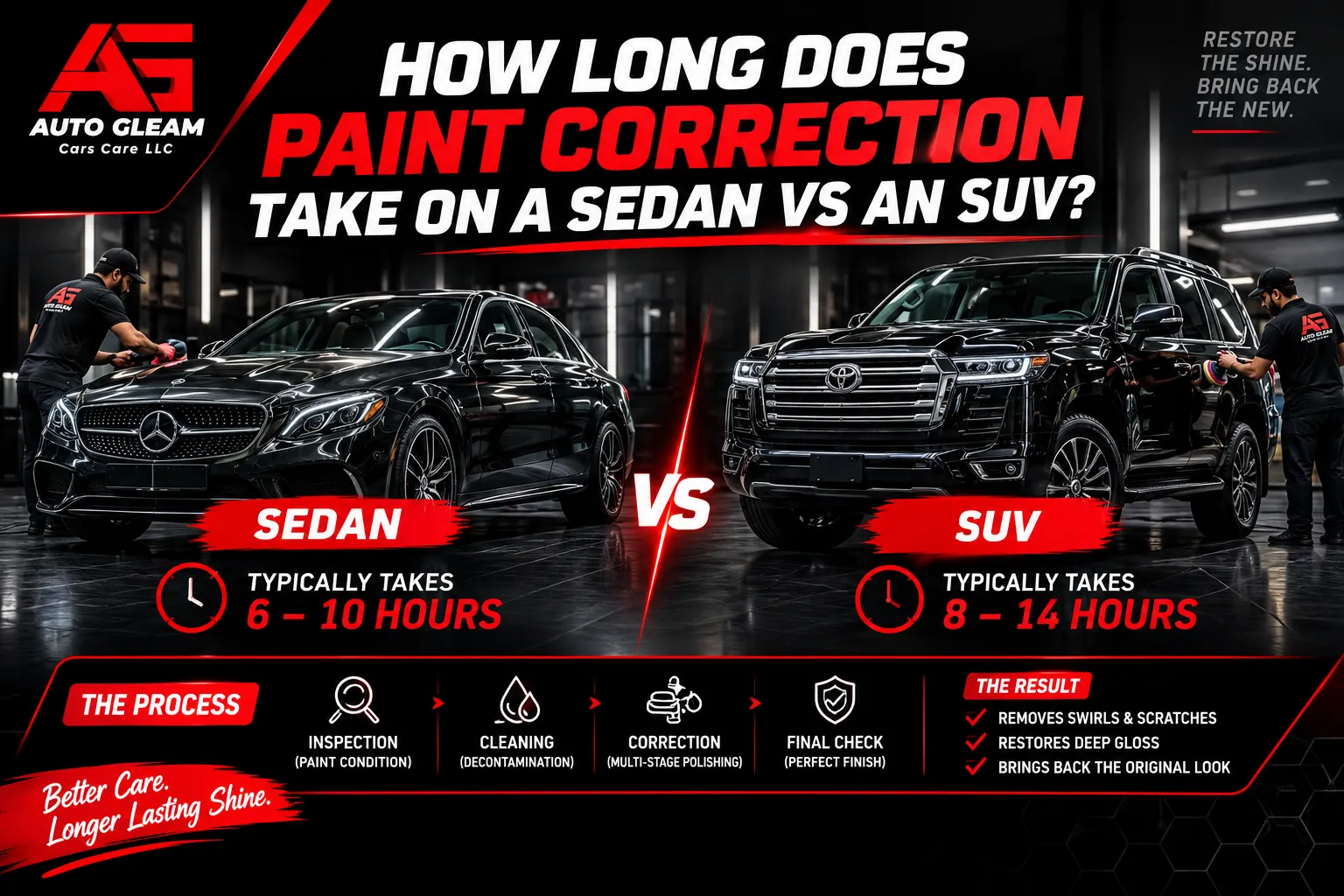
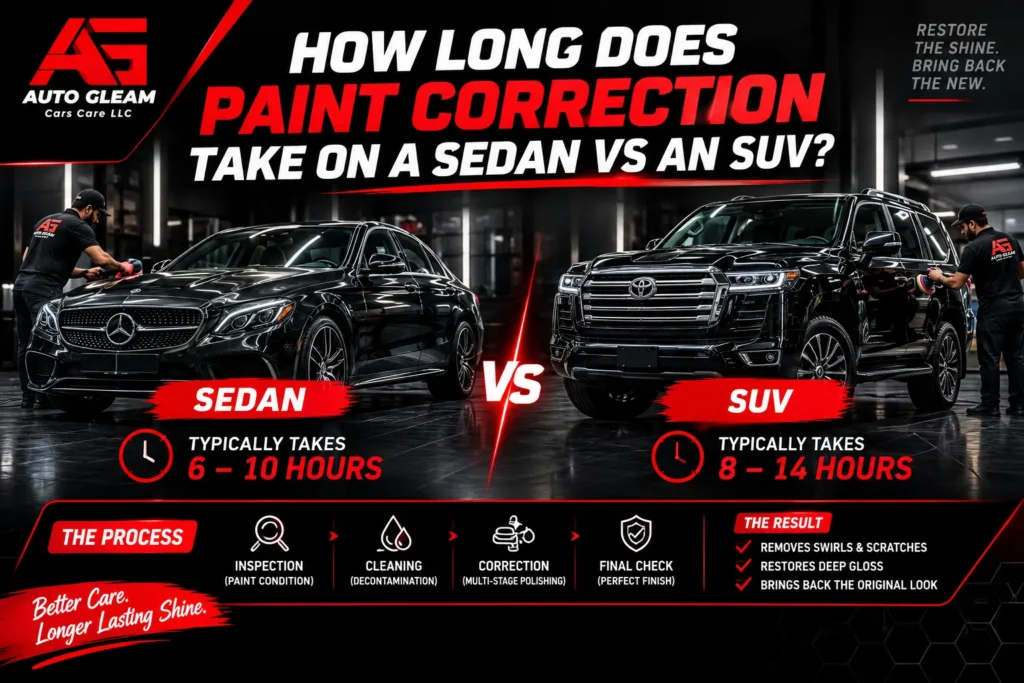
Ask ten detailers how long paint correction takes and you’ll probably get ten slightly different answers, and none of them are wrong. That’s because paint correction isn’t a fixed-time service like a wash or an oil change. It’s a craft process where the timeline depends on the size of the vehicle, the condition of the paint, the level of finish you’re after, and how careful the person doing the work chooses to be.
Still, that doesn’t help much if you’re trying to plan your week and figure out how long you’ll be without your car. So let’s do this properly. This guide walks through what actually drives the timeline, what a realistic range looks like for a sedan compared to an SUV, why the bigger vehicle doesn’t just take “a bit longer,” and how to spot the difference between a job that’s been done thoroughly and one that’s been rushed.
What Paint Correction Actually Involves
Before comparing vehicles, it helps to be clear about what’s being timed. Paint correction is the process of removing defects from the clear coat, things like swirl marks, fine scratches, water spot etching, oxidation, and hologram-like marring, by carefully leveling the surface with machine polishers, pads, and abrasive compounds or polishes.
It Is Not Just Polishing
A quick polish to add gloss is a very different job from true correction. Correction is about physically removing a microscopic layer of clear coat to level out the defects, then refining the finish until the surface reflects light cleanly. That takes measurement, testing, patience, and multiple passes on every panel.
The Work Before the Polisher Comes Out
Here’s what surprises many owners: a meaningful chunk of the total time is spent before any correction happens. The car needs a thorough wash, chemical decontamination to dissolve iron particles and industrial fallout, clay treatment to remove bonded contaminants, and careful drying. Trim, badges, and edges are masked off to protect them from the polisher. Paint thickness is measured across panels so the detailer knows how much material can safely be removed. Skipping or rushing any of this is how paint gets damaged.
The Short Answer: Typical Time Ranges
Every job is different, but as a general guide, here’s what most owners can reasonably expect. These are typical ranges rather than guarantees, and a good detailer will give you a specific estimate after inspecting your actual paint.
Sedan
- Light, single-stage correction (enhancement polish): often roughly one working day
- Medium correction (two stages): commonly around one and a half to two days
- Heavy, multi-stage correction: can stretch to two to three days or more, depending on the paint
SUV
- Light, single-stage correction: often around one to one and a half days
- Medium correction (two stages): commonly two to three days
- Heavy, multi-stage correction: frequently three to four days or longer
Notice that the gap between a sedan and an SUV grows as the level of correction increases. That’s not accidental, and the next sections explain why.
Why an SUV Takes Longer Than a Sedan
Simply More Paint to Correct
This is the obvious factor, but the scale is bigger than most people expect. A typical SUV has considerably more painted surface area than a sedan of comparable class. Taller doors, a larger bonnet, a big flat roof, a tall rear tailgate, and thicker lower body panels all add up. More surface area means more machine passes, and every panel typically needs several passes at each stage.
Working at Height
Correcting a roof on a sedan is a relatively comfortable reach. On a tall SUV, the roof and upper tailgate often require platforms or steps, careful positioning, and slower, more deliberate machine control. Working overhead at awkward angles is physically slower and needs more care to maintain consistent pressure and pad angle, which directly affects finish quality.
Larger, Flatter Panels Show Everything
Big, flat panels like SUV doors and roofs are unforgiving. Any inconsistency in the finish shows up clearly under inspection lighting and in direct sun. That means detailers often spend longer checking, wiping down, and refining these panels to get a uniform result across such a large area.
More Complex Body Features
Many SUVs have roof rails, body cladding, wheel arch trim, roof spoilers, and pronounced body creases. Each of these needs careful masking and hand work around edges where a machine polisher can’t safely reach. Plastic cladding also needs separate treatment, so it isn’t stained or damaged by compound residue.
Heavier Paint Defects From Ground-Level Exposure
Because SUVs sit higher and are often driven on rougher surfaces, lower panels tend to collect more stone chips, tar, and road grime. Cleaning and decontaminating these areas thoroughly before correction can add noticeable time.
What Actually Determines the Timeline, Beyond Vehicle Size
Size is only one variable. In fact, paint condition often matters more than whether the car is a sedan or an SUV. A lightly marred SUV can take less time than a badly swirled sedan.
Paint Condition and Defect Severity
The heavier the defects, the more aggressive the process needs to be, and the longer it takes. Light swirl marks from regular washing might clear in a single stage. Deep scratches, heavy oxidation, or dense, widespread marring often require a cutting stage with a more aggressive compound, followed by a refining stage, and sometimes a final finishing stage to remove any haze left by the cutting step.
Paint Hardness
Not all paint behaves the same. Some manufacturers use harder clear coats that resist scratching well but are slower and more difficult to correct. Others use softer paints that correct quickly but also mark easily and need gentler handling. A detailer will typically test a small section first to see how the paint responds before deciding on the pad and polish combination.
Paint Thickness
Every correction removes a tiny amount of clear coat, so a detailer needs to know how much is available to work with. Thin paint, particularly on previously corrected or repainted areas, limits how aggressive the process can be. This can actually slow the job down, since a more cautious, multi-step approach with gentler products takes longer than a single aggressive pass would.
Paint Color
Dark colors, especially black, show every imperfection in bright light, which raises the bar for what counts as an acceptable finish. Detailers often spend longer refining dark-colored vehicles because there’s nowhere for leftover haze or micro-marring to hide. Lighter colors like white and silver are more forgiving visually, though they can still hide defects that become visible under proper inspection lighting.
The Number of Correction Stages
This is the biggest single driver of time. Each stage, meaning a full pass over the entire vehicle with a specific pad and product, adds hours. The more stages a job needs, the longer the total, and the difference between a one-stage and a three-stage job on the same car can be more than double the working time.
The Desired Level of Finish
There’s a difference between removing most visible defects and pursuing a near-flawless result. Chasing that last percentage of perfection takes disproportionately more time than getting the first eighty percent, and a good detailer will discuss realistic expectations with you upfront based on your paint and your goals.
Understanding the Stages of Paint Correction
Single-Stage Correction (Enhancement Polish)
One machine polishing pass with a medium-grade polish. This typically removes a good portion of light swirl marks and restores gloss, but it isn’t designed to remove deeper scratches. It’s the fastest and gentlest option and is ideal for newer cars or paint in generally good condition.
Two-Stage Correction
A cutting stage with a more abrasive compound to level the majority of defects, followed by a refining stage with a finer polish to remove the haze the first stage leaves behind and restore clarity. This is the most common professional approach for cars with noticeable, moderate paint damage.
Three-Stage or Multi-Stage Correction
Used on heavily damaged paint, where a heavy cutting stage, a medium stage, and a final finishing stage are all needed to bring the surface to a high standard. It takes the longest and is generally reserved for cases where defects are severe or where an exceptional finish is the goal.
A Realistic Timeline, Broken Down by Phase
Rather than thinking of correction as one block of time, it helps to see how the hours are actually spent. Here’s roughly how a medium correction on a sedan compares to an SUV, in proportional terms.
Phase One: Wash and Decontamination
A thorough wash, iron decontamination, and clay treatment take a few hours on a sedan and noticeably longer on an SUV, since there’s more surface to work through, and lower panels tend to carry heavier contamination.
Phase Two: Inspection and Test Spots
Measuring paint thickness, examining defects under inspection lighting, and running test spots to select the right pad and polish combination takes a comparable amount of time on both vehicles. This is a fixed cost, since it’s about decision-making rather than surface area.
Phase Three: Masking and Preparation
Taping trim, rubber seals, badges, and sensitive edges. SUVs generally take longer here because of additional cladding, rails, and trim pieces that need protecting.
Phase Four: Cutting Stage
The most time-intensive phase. Every panel is worked in small sections, typically a square foot or two at a time, with several overlapping passes, wiping and inspecting after each section. This is where the sedan-to-SUV time gap is widest, since the total number of sections scales directly with surface area.
Phase Five: Refining Stage
A second full pass with a finer polish. This stage is usually faster per section than the cutting stage, but it still covers the whole vehicle and still scales with size.
Phase Six: Final Inspection and Wipe-Down
Removing polish residue with an appropriate panel wipe solution and inspecting the finish under different lighting angles. Any remaining defects or missed spots get a second look. Larger vehicles simply take longer to inspect thoroughly.
Phase Seven: Protection
Once the paint is corrected, it needs protection, whether that’s a sealant, wax, or ceramic coating. Ceramic coating in particular adds curing time, and this is often the reason people are told to leave the vehicle for a day or two longer than the correction alone would take.
Sedan vs SUV: A Direct Comparison
Surface Area
The SUV has considerably more paint to correct, and the difference compounds across every stage of the process.
Physical Access
Sedans are generally easier to work around at a comfortable height. SUVs require reaching, stepping up, and working overhead, all of which slow the process while keeping quality consistent.
Trim and Masking Complexity
SUVs typically have more cladding, rails, and trim that need protecting and detailing separately, which adds to the preparation phase.
Contamination Level
SUVs often carry heavier lower-body contamination because of their height and typical usage, which adds to the decontamination phase.
Panel Consistency
Large flat panels on SUVs make finish inconsistencies more visible, which typically requires more careful refinement and inspection time.
Signs a Correction Job Is Being Rushed
A shorter timeline isn’t automatically a good thing. Here are signs that a job is being done too quickly to deliver a proper result.
No Inspection or Paint Thickness Measurement
If nobody checks your paint before starting, they’re guessing how much can safely be removed. That’s how paint gets burned through on thin areas.
A Full Correction Promised Within a Few Hours
A genuine multi-stage correction on a full vehicle isn’t a few-hour task, whatever the vehicle size. A promise of dramatic results in a very short window usually means it’s a quick polish rather than true correction.
No Test Spot
Professionals test their pad and product combination on a small section before committing to the whole car. Skipping this step suggests a one-size-fits-all approach that may not suit your paint.
Vague Answers About the Process
A detailer who genuinely knows their craft can explain what stages your car needs and why. If the answers are vague or dismissive, that’s worth noting.
Signs a Job Is Being Done Properly
You’re Given an Honest Timeline Range
Good detailers give a realistic estimate after seeing the paint, and often mention that the timeline might adjust once they start working and see how the paint responds.
They Explain the Limits
Honest professionals will tell you that not every scratch can be fully removed, especially deep ones that have gone through the clear coat, and they’ll explain what’s realistic for your particular paint condition.
They Inspect Under Proper Lighting
Dedicated inspection lights reveal defects that are invisible in normal lighting. A shop that uses them is checking its own work honestly.
Can You Speed Up the Process?
Arriving With a Clean Car Helps Slightly
A reasonably clean car doesn’t skip the decontamination phase, but it does mean less initial washing effort.
Being Flexible With the Timeline
Rushing a good detailer usually hurts the result. Leaving some buffer in the schedule, rather than demanding a specific finish time, tends to lead to a better outcome.
Being Clear About Your Expectations
Telling the detailer whether you want a flawless showroom finish or a solid, practical improvement helps them plan the right number of stages, which directly shapes the timeline.
Does Ceramic Coating Add to the Timeline?
Yes, if it’s part of the plan. Ceramic coating application typically adds several hours of careful surface preparation and application, plus a curing period during which the vehicle needs to stay protected from water and contamination. Many owners choose to combine correction and coating in a single visit, since coating over freshly corrected paint locks in the improved finish and protects it. Just plan for the vehicle to be with the detailer longer as a result.
Final Thoughts
A sedan will generally take less time than an SUV for the same level of paint correction, because there’s less surface area, easier access, and less complex trim to work around. But the more important takeaway is that vehicle size is only one piece of the puzzle. Paint condition, hardness, thickness, color, and the finish you’re after all influence the timeline just as much, sometimes more. A thorough job on either vehicle takes real time, and a detailer who’s honest about that, inspects carefully, and doesn’t rush the process is far more likely to deliver a result you’ll be happy with for years.
Frequently Asked Questions
How long does paint correction take on a sedan?
It depends on the level of correction, but as a general guide, a light single-stage job may take around a day, while a medium two-stage correction commonly takes around one and a half to two days, and heavy correction can take longer.
How long does paint correction take on an SUV?
SUVs typically take longer because of their larger surface area and more complex trim. A medium correction commonly runs around two to three days, and heavier work can take three to four days or more.
Why does an SUV take so much longer than a sedan?
More paint surface, working at height on the roof and tailgate, additional trim and cladding to mask, and often heavier lower-body contamination all add time at every stage.
Can paint correction be done in a single day?
A light single-stage enhancement polish on a sedan can often be completed in about a day, but a genuine multi-stage correction generally needs more time to be done properly.
What’s the difference between paint correction and polishing?
Polishing usually refers to improving gloss, while true correction physically levels the clear coat to remove defects like swirl marks and scratches, using multiple stages when needed.
Does the color of my car affect how long correction takes?
Yes, dark colors show imperfections more clearly, so detailers often spend longer refining them to reach an acceptable finish, while lighter colors are somewhat more forgiving visually.
Will paint correction remove all scratches?
Not always. Light to moderate scratches and swirl marks usually correct well, but deep scratches that have penetrated through the clear coat can only be improved, not fully removed, without repainting.
Is it safe to correct paint multiple times?
Each correction removes a tiny layer of clear coat, so there’s a limit to how many times it can be safely done. Measuring paint thickness beforehand helps determine how much material is available to work with.
How can I tell how many stages my car needs?
A professional inspection under proper lighting, combined with paint thickness measurement and a test spot, is the reliable way to determine how many stages your specific paint needs.
Does new car paint need correction?
Often, yes. New cars can carry light marring from transport, handling, and dealership washing, and many owners choose a light single-stage polish before applying protection.
Can I drive my car while waiting for a multi-day correction?
Generally the vehicle needs to stay with the detailer until the work is complete, since the process is done panel by panel and the paint needs to be protected from contamination during the process.
Does paint correction include ceramic coating?
Not automatically. They’re separate services, though many owners combine them, since coating protects the freshly corrected paint. Adding coating extends the overall timeline because of application and curing time.
How long should I wait to wash my car after paint correction?
If a ceramic coating was applied, the detailer will give specific curing instructions, often involving a short period of keeping the car dry and avoiding washing. For correction with a standard sealant, guidance varies, so it’s best to follow the detailer’s recommendation.
Is hand correction as effective as machine correction?
Hand polishing can improve very light defects, but it generally can’t match the consistency and defect removal of machine polishing, especially across large panels, and it takes far more physical effort and time.
What can make a correction job take longer than expected?
Harder-than-expected paint, thin clear coat requiring a gentler approach, heavier defects than were visible during initial inspection, and additional issues discovered mid-process can all extend the timeline.
How often should paint correction be done?
It doesn’t need to be a regular routine. With proper washing technique and protection like a coating or sealant, many vehicles only need correction occasionally, and light maintenance can help avoid the need for heavy correction later.
Does a bigger sedan take the same time as a small SUV?
Not necessarily. A large luxury sedan can approach the surface area of a compact SUV, so the vehicle’s actual size and complexity matter more than its body style label alone.
Should I be worried if my detailer says it will take longer than quoted?
Not necessarily. Paint behavior can differ from expectations once work begins, and a detailer who communicates a change and explains why is generally showing care, not incompetence. Good communication matters most.